
Avhigat Akhara
Traditional Ascetic Hermitage & Vedic Lineage
Preserving Eternal Sanatan Dharma and Divine Guru Parampara
Membership Contact Us
श्रीगणेशः / विनायकः / गणपतिः

Lord Ganesha

The Lord of Wisdom, Auspicious Beginnings & Remover of All Obstacles
Lord Ganesha is the beloved deity of intellect, humility, and good fortune, whose grace removes hindrances and establishes peace at every step.
Revered Names & Sacred Epithets:
Ganesh Ganesha Ganapati Vinayaka Vighneshwara Gajanana Ekadanta Lambodara Vighnaharta
Scripturally Verified Hub 6 Approved Works Quality 98.5/100
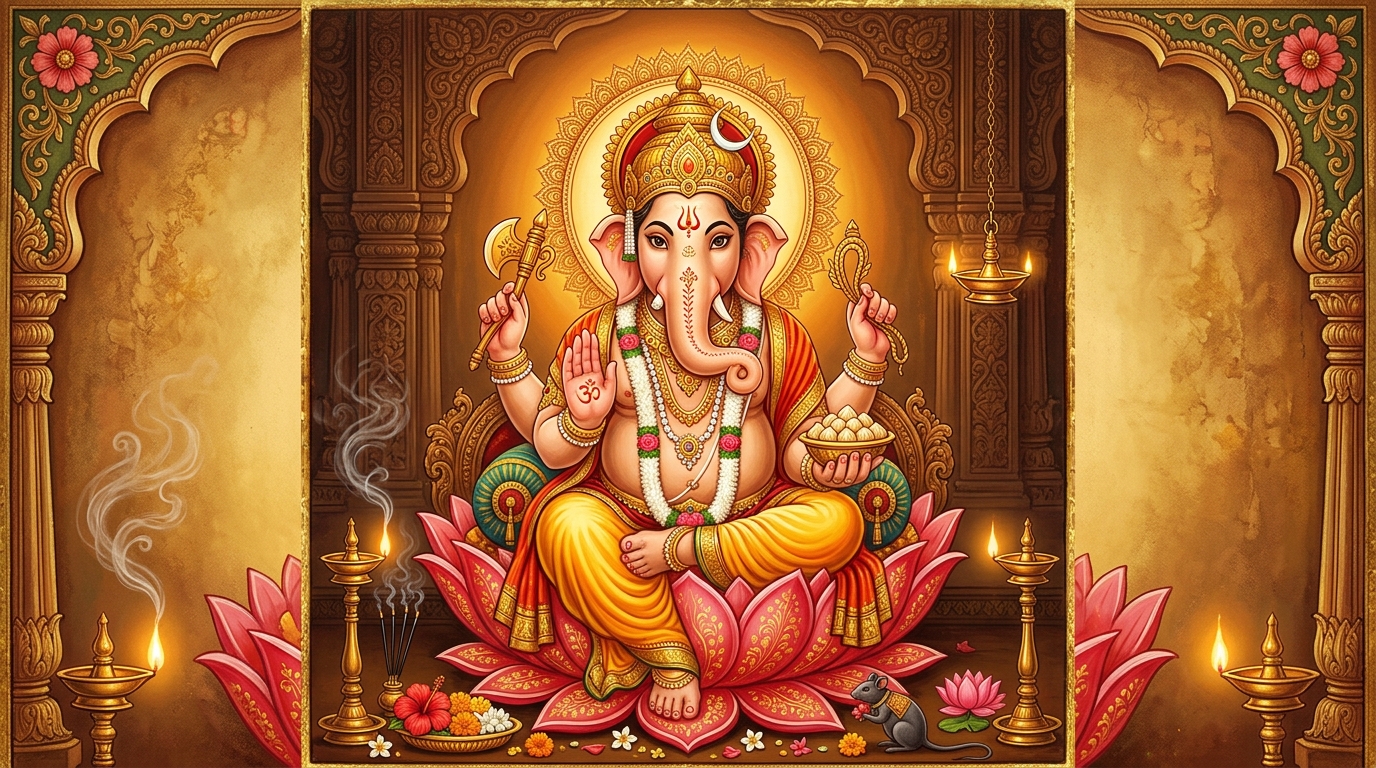
Lord Ganesha seated on sacred red lotus holding axe, pasha, modaka, and blessing with abhaya mudra.
Artwork Source: Avhigat Akhara Sacred Archive
Sacred Identity & Context

Understanding Lord Ganesha in Hindu Traditions

With His magnificent elephant head and gentle gaze, Ganesha personifies supreme intellect (Buddhi) united with discrimination and inner sweetness (Modaka).

He teaches seekers to listen deeply (large ears), retain only what is wholesome (sifting trunk), and speak only what is truthful and necessary. His small vehicle, the mouse (Mushaka), illustrates that even restless desires can be mastered and guided toward divine wisdom.

Whether beginning a new venture, starting spiritual practice, or seeking clarity during difficult decisions, approaching Ganesha brings calm reassurance and practical discernment.
Scriptural & Tradition Context

In the Ganapatya tradition and standard Vedic ritual (Prathama Pujya vidhi), Lord Ganesha is invoked at the very threshold of every spiritual ceremony, study, journey, and life transition. He represents the Muladhara chakra—the foundational stability of consciousness.

Sacred Emblems

Sacred Iconography & Symbolic Meaning

The sacred iconography of Lord Ganesha reveals deep spiritual truths:
• Elephant Head: Vast cosmic intellect and boundless patience.
• Broken Tusk (Ekadanta): Sacrifice of personal pride in the service of preserving sacred wisdom (the writing of Mahabharata).
• Large Ears: The paramount importance of patient, discerning listening before taking action.
• Modaka: The ultimate sweet fruit of spiritual liberation (Moksha Ananda).
• Mouse: Subduing small, nibbling desires through steady contemplation.
Verified Devotional Library

Approved Sacred Texts & Prayers for Lord Ganesha

Authoritative, canonical scriptures and prayers dedicated to Lord Ganesha. Each text links to its dedicated reader with authentic Devanagari verses, transliteration, and simple meanings.

Chalisa

1
Chalisa Verified

Shri Ganesh Chalisa

Shri Ganesh Chalisa
Shri Ganesh Chalisa is a vibrant forty-verse hymn dedicated to Lord Ganesha, the harbinger of auspicious begin...
0 Verses Read Text

Aarti

1

Stotra & Stotram

2

Namavali

1

Vrat, Puja & Festivals

1
Spiritual Discipline

Related Sadhana & Spiritual Upasana

Authoritative Practice
Ganesh Siddhi Sadhana
Ganesh Siddhi Sadhana is a focused spiritual practice centered on Lord Ganesha, the remover of obstacles and the giver of wisdom. In the Sanatan tradition, no s...
Guidance: Deeper contemplative disciplines require sincere practice and Guru guidance.
Auspicious Days & Fasting

Sacred Observances, Fasts & Festivals

Annual & Monthly Sacred Days

Ganesh Chaturthi (Bhadrapada Shukla Chaturthi), Monthly Sankashti Chaturthi, and Vinayaka Chaturthi.
Devotional Rule: Devotees chant the sacred Atharvashirsha Upanishad, Ganesha Pancharatnam, and Sankata Nashana Stotram with offerings of fresh durva grass and modakas. His worship encourages simplicity, intellectual clarity, and warmth toward all living beings.
Authenticity & Bibliography

Scriptural Sources, Review & Governance

Primary Classical Scriptural References:
  • Ganapati Atharvashirsha Upanishad — Atharvaveda Parishishta (Sovereign Vedic Invocation)
  • Ganesha Purana — Classical Sanskrit Recension (Upasana Khanda)
  • Ganesha Pancharatnam — Sri Adi Shankaracharya Stotravali (Five Jewel Stanzas on Vinayaka)
॥ Authoritative Shastric Guidance ॥

Classical Context & Seekers Questions

Authoritative answers, ritual disciplines, and scriptural citations for sincere practitioners.

Q1
Theological Puranic Agamic

Why is Lord Ganesha called Ekadanta (the Single-Tusked One)?

Context Note: Theological significance of Lord Ganesha as Ekadanta.
Summary Answer

Lord Ganesha is called Ekadanta because he sacrificed one of his tusks to write the Mahabharata as dictated by Sage Veda Vyasa without interruption. Philosophically, it represents non-duality (Advaita).

The Ganesha Purana and Mudgala Purana present Ekadanta as the unifier of all polarities. The single tusk stands for non-duality beyond pairs of opposites (pleasure-pain, good-evil). Puranic lore recalls that when Sage Vyasa required an unbroken scribe for the great epic, Ganesha broke his right tusk to continue writing when the pen splintered. Furthermore, the Mudgala Purana associates the Ekadanta incarnation with overcoming the demon Madasura (arrogance and intellectual pride).
Classical Scriptural Sources
Mudgala Purana Verified

Author/Rishi: Maharshi Mudgala

Ekadanta Charita • Adhyaya 4, Shlokas 11-29

Chowkhamba Sanskrit Series

Mahabharata (Adi Parva) Verified

Author/Rishi: Maharshi Veda Vyasa

Anukramanika Parva • Adhyaya 1, Shlokas 74-79

BORI Critical Edition

Related Concepts: #Sadhana #Seva
Q2
Ritual Puranic Agamic

What is the classical practice and phalashruti of the Sankata Nashana Ganesha Stotram?

Context Note: Ganesha as Vighnaraja, the remover of all obstacles.
Summary Answer

Composed by Devarshi Narada, reciting these 12 sacred names of Ganesha at morning, noon, and twilight eradicates obstacles, grants progeny, wealth, and freedom from fear within six months.

The Narada Purana outlines the 12 names: Vakratunda, Ekadanta, Krishna Pingaksha, Gajavaktra, Lambodara, Vikata, Vighnaraja, Dhumravarna, Bhalachandra, Vinayaka, Ganapati, and Gajanana. Chanting it before commencing any study, travel, or project dispels latent anxieties. Writing this hymn and dedicating it to eight Brahmins (or pure seekers) yields instantaneous intellectual clarity and success.
Classical Scriptural Sources
Narada Purana (Uttara Bhaga) Verified

Author/Rishi: Devarshi Narada

Sankata Nashana Stotra Adhyaya • Shlokas 1-8

Gita Press, Gorakhpur

Related Concepts: #Sadhana #Mantra
॥ श्री गुरु चरण सरोज रज ॥

One-to-One Samasya Samadhan

Confidential Guidance

Private guidance from Guru Ji and the Akhara's guides. Choose what you need help with.