
Avhigat Akhara
Traditional Ascetic Hermitage & Vedic Lineage
Preserving Eternal Sanatan Dharma and Divine Guru Parampara
Membership Contact Us
भगवान् विष्णुः / नारायणः / श्रीहरिः

Lord Vishnu

The Supreme Preserver of Dharma, Cosmic Order & Ocean of Compassion
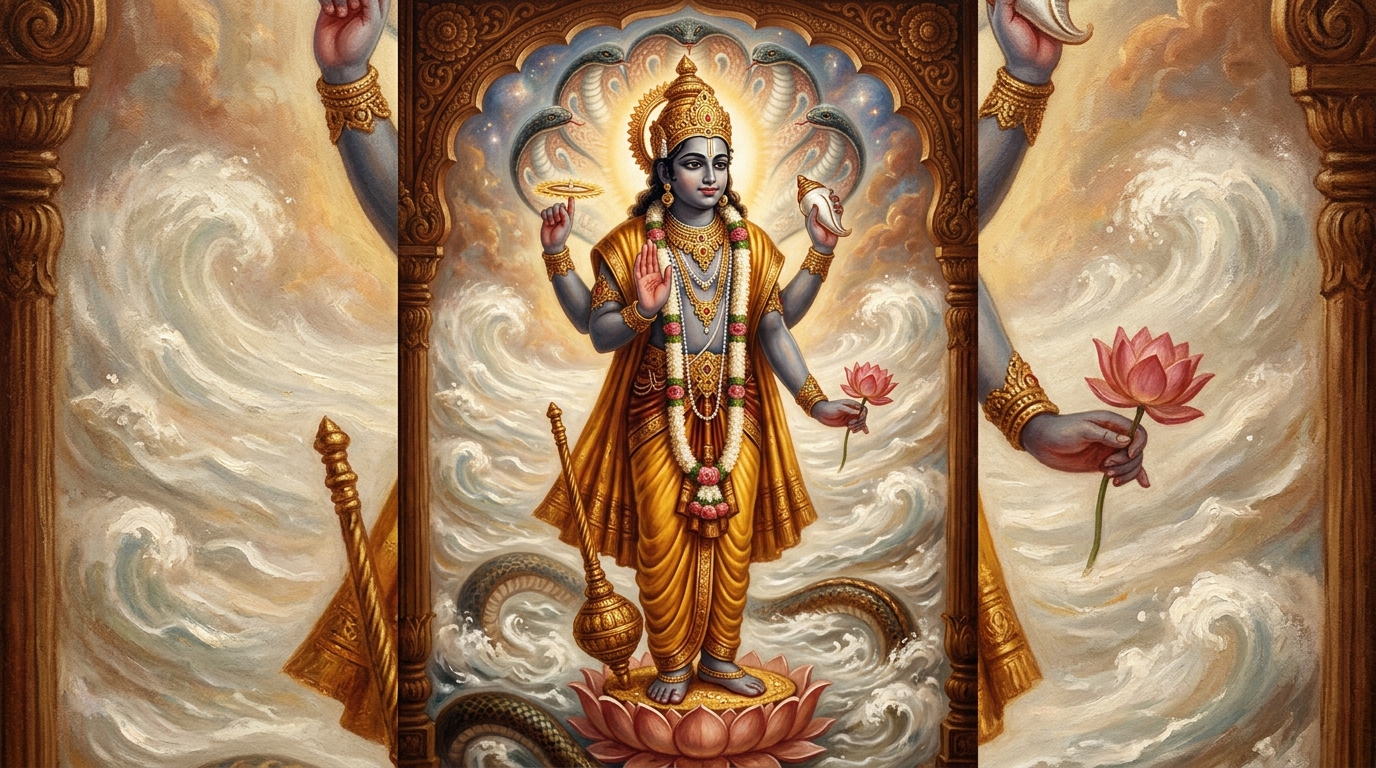
Lord Vishnu is the peaceful sustainer of the universe, resting serenely upon the serpent Ananta in the cosmic ocean, holding the emblems of protection and moral order.
Revered Names & Sacred Epithets:
Vishnu Narayan Narayana Sri Hari Hari Jagannath Vasudeva Madhava Govinda
Scripturally Verified Hub 7 Approved Works Quality 98.5/100
Lord Vishnu standing with four arms holding Shankha, Chakra, Gada, and Padma in the cosmic ocean.
Artwork Source: Avhigat Akhara Sacred Archive
Sacred Identity & Context

Understanding Lord Vishnu in Hindu Traditions

The word 'Vishnu' originates from the Sanskrit root 'Vish' meaning to pervade—He who permeates every atom of existence as love, order, and life-breath.

His role is not passive; He sustains righteousness through eternal vigilance. From His supreme celestial abode, He descends in bodily forms such as Shri Rama—the ideal of duty and honor—and Shri Krishna—the master of divine love and wisdom in the Bhagavad Gita.

Worshipping Vishnu cultivates equanimity, purity of speech, devotion to ethical conduct, and compassionate living.
Scriptural & Tradition Context

In classical Vedanta and Vaishnava traditions, Lord Vishnu (Narayana) is the supreme all-pervading reality (Sarvavyapi) who sustains cosmic harmony, protects virtue, and repeatedly descends across ages as Avataras whenever Dharma declines.

Sacred Emblems

Sacred Iconography & Symbolic Meaning

The four sacred attributes held by Lord Vishnu symbolize cosmic functions:
• Shankha (Conch - Panchajanya): The primordial vibration of Dharma banishing fear and confusion.
• Sudarshana Chakra (Discus): The sharp wheel of righteous time cutting through ignorance and pride.
• Gada (Mace - Kaumodaki): Authority, spiritual discipline, and moral governance.
• Padma (Lotus): Purity, beauty, and liberation blooming above the worldly waters.
Verified Devotional Library

Approved Sacred Texts & Prayers for Lord Vishnu

Authoritative, canonical scriptures and prayers dedicated to Lord Vishnu. Each text links to its dedicated reader with authentic Devanagari verses, transliteration, and simple meanings.

Aarti

1

Stotra & Stotram

1

Sahasranama

1

Vrat, Puja & Festivals

1
Auspicious Days & Fasting

Sacred Observances, Fasts & Festivals

Annual & Monthly Sacred Days

Ekadashi Vrats (all 24 annual fasts, notably Nirjala and Vaikuntha Ekadashi), Kartik Purnima, and Gita Jayanti.
Devotional Rule: Recitation of the Vishnu Sahasranama Stotram and contemplation of the Bhagavad Gita are regarded as the highest spiritual practices for developing detachment and devotion. Devotees observe simple, sattvic vegetarian meals and truthful speech.
Authenticity & Bibliography

Scriptural Sources, Review & Governance

Primary Classical Scriptural References:
  • Mahabharata (Anushasana Parva) — Critical Edition BORI / Gita Press (Adhyaya 149) (Sri Vishnu Sahasranama Stotram)
  • Shrimad Bhagavad Gita — Gita Press Gorakhpur (Code 284) (The Song Divine of Lord Krishna)
  • Vishnu Purana — Gita Press Gorakhpur (Code 114) (Amsha 1–6, Cosmic Sustenance)
॥ Authoritative Shastric Guidance ॥

Classical Context & Seekers Questions

Authoritative answers, ritual disciplines, and scriptural citations for sincere practitioners.

Q1
Scriptural Vaishnava / Ramanandi

Under what circumstances was the Shri Vishnu Sahasranama revealed in the Mahabharata?

Context Note: Lord Vishnu as the Supreme All-Pervading Being (Vishva).
Summary Answer

Bhishma Pitamaha revealed the 1,000 names of Lord Vishnu to Yudhishthira from his bed of arrows (Sharashayya) in the Anushasana Parva, in the presence of Bhagavan Shri Krishna.

Following the Kurukshetra war, King Yudhishthira asked Bhishma: "Kimekam daivatam loke kim vapyekam parayanam?" (Who is the one supreme deity in the universe, and who is the ultimate refuge?). Bhishma responded that constant devotion and recitation of the thousand names of the omnipresent Vishnu (Pavitranam Pavitram - the purest among purifiers) is the supreme dharma above all sacrifices, requiring neither sacrificial fire nor strict outer rituals.
Classical Scriptural Sources
Mahabharata (Anushasana Parva) Verified

Author/Rishi: Maharshi Veda Vyasa

Danasadharma Parva, Adhyaya 149 • Shlokas 1-142

BORI Critical Edition / Gita Press

Vishnusahasranama Bhashya Verified

Author/Rishi: Jagadguru Adi Shankaracharya

Upodghata (Introduction) • Introductory Commentary

Advaita Ashrama / Gita Press

Q2
Theological Vaishnava / Ramanandi

What do the four emblems held in Lord Vishnu's four arms signify?

Context Note: Cosmic symbolism of the four divine ayudhas of Lord Vishnu.
Summary Answer

The Shankha (Panchajanya) represents cosmic sound (AUM); the Sudarshana Chakra represents cosmic mind and the cycle of time; the Kaumodaki Gada represents intellect and cosmic law; and the Padma (Lotus) represents spiritual unfolding and purity.

The Vishnu Purana explains the cosmic metaphysics behind the Chaturbhuja (four-armed) form: The Conch creates the primordial vibration from which space and matter expand. The Discus cuts through the illusion of maya and destroys adharmic forces with the speed of pure thought. The Mace crushes ignorance and enforces divine order. The Lotus blossoming untouched above muddy water reminds the seeker to live in the world with spotless purity and selfless devotion.
Classical Scriptural Sources
Vishnu Purana Verified

Author/Rishi: Maharshi Parashara

Amsha 1, Adhyaya 22 • Ayudha Vivechana Shlokas 68-76

Gita Press, Gorakhpur

Related Concepts: #Sadhana #Seva
Q3
Scriptural Smarta / Vedic

What does the "Cosmic Sacrifice" (Yajna) represent in the Purusha Suktam (Rigveda 10.90)?

Context Note: The Cosmic Form (Vishvarupa) of Lord Narayana.
Summary Answer

The Purusha Suktam envisions creation not as a material collision, but as a voluntary cosmic sacrifice (Yajna) wherein the Supreme Being manifests the multiverse from His own unmanifest fullness.

Verse 16 states: "Yajnena yajnam ayajanta devas tani dharmani prathamany asan" (With sacrifice the Devas offered sacrifice to the Supreme; those were the earliest primal ordinances). The Sukta explains that one-fourth of the Purusha is this manifest cosmos, while three-fourths remain immortal in the transcendent realm. It establishes that sacrifice, mutual inter-dependence, and self-giving are the fundamental fabric of existence.
Classical Scriptural Sources
Rigveda Samhita Verified

Author/Rishi: Rishi Narayana (Drashta)

Mandala 10, Sukta 90 • Richas 1-16

Vaidika Samshodhana Mandala, Pune

Shukla Yajurveda (Vajasaneyi Samhita) Verified

Author/Rishi: Maharshi Yajnavalkya

Adhyaya 31 • Purushasukta Prakarana

Chowkhamba Sanskrit Series

Related Concepts: #Sadhana #Seva
Q4
Ritual Vaishnava / Ramanandi

Why are grains strictly prohibited during Ekadashi fasting?

Context Note: Devotion to Lord Vishnu through bi-monthly lunar fasting.
Summary Answer

Both scripturally and biologically, consuming grains on the 11th lunar day (Ekadashi) strains the digestive agni and dulls mental clarity when the moon's gravitational pull draws internal bodily fluids upwards.

The Padma Purana and Narada Purana recount the allegorical narrative of Papapurusha taking refuge in five grains on Ekadashi. Physiologically, fasting from grains allows the body to undergo deep cellular detoxification. The mind, being subtle food (annamayakosha), remains calm, enabling uninterrupted meditation and japa on Lord Vishnu. Fasting concludes on Dvadashi morning during the prescribed Parana muhurta.
Classical Scriptural Sources
Padma Purana (Uttara Khanda) Verified

Author/Rishi: Gita Press Edition

Ekadashi Mahatmya Prakarana • Adhyaya 40-42

Gita Press, Gorakhpur

Related Concepts: #Sadhana
॥ श्री गुरु चरण सरोज रज ॥

One-to-One Samasya Samadhan

Confidential Guidance

Private guidance from Guru Ji and the Akhara's guides. Choose what you need help with.