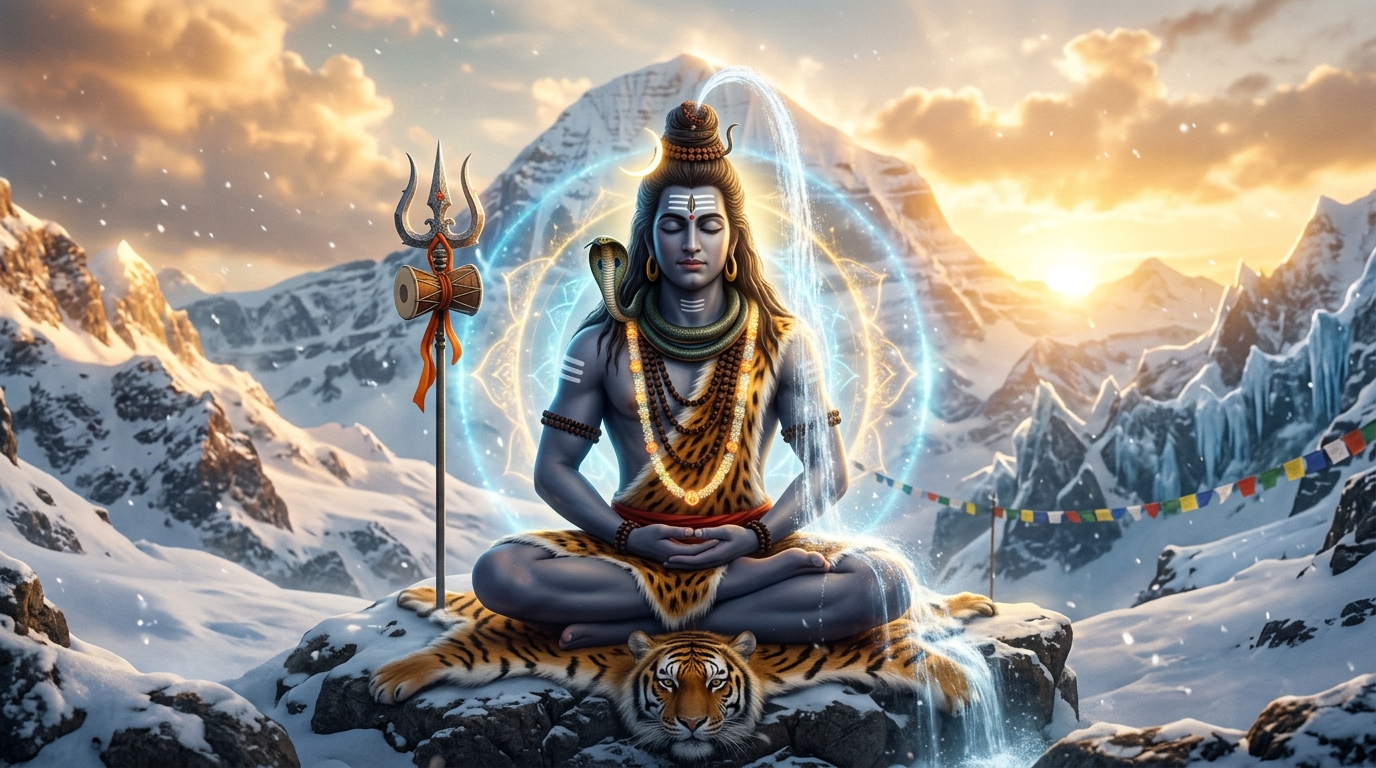
Composed by: Traditionally attributed to Ravana (Dashanana)
Composed in the dynamic Panchachamara meter, the Shiva Tandava Stotram is a cosmic Sanskrit masterpiece describing the ecstatic cosmic dance of Lord Shiva. It captures the rhythm of creation, dissolution, and divine transcendence through majestic alliteration and profound poetic resonance.
8 mins chanting
16 Shlokas
Sanskrit Shlokas & Meter
Text review in progress
Composed in the dynamic Panchachamara meter, the Shiva Tandava Stotram is a cosmic Sanskrit masterpiece describing the ecstatic cosmic dance of Lord Shiva. It captures the rhythm of creation, dissolution, and divine transcendence through majestic alliteration and profound poetic resonance.
Devotional Notice:
This sacred Stotram is presented for sincere devotional recitation, contemplation, and study from attested recensions with accurate Sanskrit shlokas and verse-by-verse bilingual meanings. Recitation customs vary across traditional lineages. Avhigat Akhara presents authentic textual editions without any claims of supernatural guarantees, financial windfalls, or commercialized promises; true spiritual peace arises from selfless devotion (Bhakti) and inner discipline (Sadhana).
Hindi Meaning:
सघन वन सदृश जटाओं से प्रवाहित होने वाली गंगा की पावन धाराओं से जिनका कंठ-प्रदेश पवित्र है, जिनके गले में विशाल सर्पों की माला लटक रही है, तथा जो डमरू के डमड्-डमड् नाद के साथ प्रचंड तांडव नृत्य कर रहे हैं, वे भगवान शिव हमारा परम कल्याण करें।
English Meaning:
With His neck consecrated by the sacred waters of the Ganga flowing from the dense forest of His matted locks, wearing a lofty serpent as a garland around His throat, and beating His damaru drum with the rhythmic resonant sound "Damad-Damad"—may that Lord Shiva expand our spiritual well-being through His dynamic cosmic dance.
The verse features magnificent onomatopoeia imitating the reverberating cosmic sound of Shiva's damaru drum.
Hindi Meaning:
जटारूपी कड़ाह में वेग से घूमती हुई देवनदी गंगा की चंचल तरंग-लताओं से जिनका मस्तक सुशोभित है, जिनके ललाट पर धक्-धक् करती प्रचंड अग्नि प्रज्वलित है, और जिनके शीश पर बालचंद्र विराजमान हैं, उन महादेव में मेरा मन प्रतिक्षण अनुरक्त रहे।
English Meaning:
Upon whose head the billowing waves of the celestial river Ganga swirl gracefully within the cauldron of His matted locks, on whose forehead the third eye blazes with intense flaming brilliance, and who bears the crescent moon upon His crest—may my mind take perpetual delight in Him.
Harmonizes the cooling nectar of Ganga and the crescent moon with the blazing fire of the third eye.
Hindi Meaning:
पर्वतराज हिमालय की कन्या पार्वती के विलासपूर्ण कटाक्षों से जिनका चित्त आनंदित रहता है, जिनकी कृपादृष्टि की अनवरत धारा भक्तों की भीषण विपत्तियों का निवारण कर देती है, उन दिगंबर शिव-तत्व में मेरा मन परम आनंद प्राप्त करे।
English Meaning:
In whose mind all living beings across the cardinal directions find joy through His gracious relationship with the daughter of the mountain king (Parvati), and whose continuous flow of compassionate glances wards off insurmountable calamities—may my mind find supreme refuge in that cosmic space-clad Divinity.
Celebrates the benevolent grace of Mahadeva that dissolves insurmountable distress for all beings.
Hindi Meaning:
जटाओं में लिपटे सर्पों के फणों की मणियों की लाल-पीली चमक से दिशाओं के मुख मानो कुंकुम से लिप्त हो गए हैं, और जो मदमस्त गजचर्म का उत्तरीय धारण किए हुए हैं, उन समस्त प्राणियों के भरण-पोषणकर्ता भूतनाथ में मेरा मन अलौकिक आनंद धारण करे।
English Meaning:
With the reddish-yellow luster radiating from the crest jewels of the serpents twined in His hair painting the faces of the directions as if smeared with saffron paste, and wearing the shimmering hide of an elephant as an upper garment—may my mind find extraordinary joy in the Sustainer of all spirits (Bhutabhartari).
Contemplates the vibrant cosmic colors created by serpent gems illuminating the four quarters of the universe.
Hindi Meaning:
इंद्र आदि समस्त देवताओं के मुकुटों में सुशोभित पुष्पों की पराग-धूलि से जिनकी चरण-पीठ धूसरित हो रही है, जिनका जटाजूट नागराज की माला से बंधा है, और जिनके शीश पर चकोर के बंधु चंद्रमा सुशोभित हैं, वे चंद्रशेखर मुझे चिरकाल तक आध्यात्मिक ऐश्वर्य प्रदान करें।
English Meaning:
Whose footstool is grayed by the streams of pollen falling from the floral crowns of Indra and all the assembled gods, whose matted hair is bound firmly by the garland of the king of serpents, and who wears the moon (kin of the Chakora bird) upon His crest—may that Chandrashekhara grant me everlasting spiritual wealth.
Depicts the supreme majesty of Shiva whose lotus feet are adored by all celestial deities.
Hindi Meaning:
जिनके ललाट-प्रांगण में प्रज्वलित अग्नि के स्फुलिंगों ने कामदेव (पंचबाण) को भस्म कर दिया था, जिन्हें देवराज इंद्र नमन करते हैं, और जो अमृत-किरणों वाले बालचंद्र से सुशोभित हैं, उन महाकपाली भगवान शिव की जटाएं हमें परम संपदा प्रदान करें।
English Meaning:
From the courtyard of whose forehead the sparks of blazing fire consumed Kamadeva (the wielder of five arrows), who is bowed to by Indra the king of gods, and whose crest is adorned by the nectar-beamed crescent moon—may the matted hair of that supreme Kapali bestow spiritual treasures upon us.
Signifies the annihilation of lust and desire through the blazing fire of spiritual knowledge.
Shloka 7: The Cosmic Sacrifice
#7 / 16
करालभालपट्टिकाधगद्धगद्धगज्ज्वल-
द्धनञ्जयाहुतीकृतप्रचण्डपञ्चसायके ।
धराधरेन्द्रनन्दिनीकुचाग्रचित्रपत्रक-
प्रकल्पनैकशिल्पिनि त्रिलोचने रतिर्मम ॥ ७ ॥
Hindi Meaning:
जिनके विशाल ललाट-पट्ट पर धगद्-धगद् जलती हुई अग्नि में कामदेव आहुति बनकर भस्म हो गया, तथा जो पार्वती के प्रति अनन्य प्रेम रखने वाले अद्वितीय शिल्पी हैं, उन त्रिलोचन शिव में मेरा नित्य अनुराग रहे।
English Meaning:
Who made an offering of the mighty Kamadeva into the raging fire blazing "dhagad-dhagad" upon the wide expanse of His forehead, and who is the supreme artist celebrating divine affection with the daughter of the mountain king—in that Three-eyed Lord may my heart ever find deep love.
Reconciles the terrifying ascetic detachment of Shiva with His supreme gentle love for the divine Mother.
Hindi Meaning:
नवीन मेघमाला से घिरी हुई अमावस्या की आधी रात के अंधकार सदृश जिनका कंठ श्यामवर्ण है, जो गंगा को धारण करने वाले, गजचर्म ओढ़ने वाले, चंद्रमा से सुशोभित तथा संपूर्ण ब्रह्मांड का भार वहन करने वाले हैं, वे शिव हमें आध्यात्मिक ऐश्वर्य प्रदान करें।
English Meaning:
Whose throat possesses the deep dark complexion of the midnight of a new moon obscured by fresh rainclouds, who holds the celestial Ganga, wears the elephant hide, is adorned with the crescent moon, and bears the weight of the universe—may that Jagaddhurandhara expand our spiritual prosperity.
Praises Nilakantha whose dark blue throat bears the cosmic poison to protect all creation.
Hindi Meaning:
खिले हुए नीलकमल के श्याम प्रभाव जैसी जिनकी कंठ की कांति है; जो कामदेव (स्मर), त्रिपुरासुर (पुर), संसार-बंधन (भव), दक्षयज्ञ (मख), गजासुर, अंधकासुर तथा यमराज (अन्तक) का दलन करने वाले हैं, उन महादेव का मैं भजन करता हूँ।
English Meaning:
Whose neck shines with the deep dark luster of a fully blossomed blue lotus; who is the destroyer of Kamadeva, the destroyer of Tripura, the destroyer of worldly bondage, the destroyer of Daksha's sacrifice, the destroyer of Gajasura, the destroyer of Andhaka, and the vanquisher of death (Yama) itself—Him I adore.
Recounts Shiva's supreme victories over mortal limitations, ignorance, and death itself.
Hindi Meaning:
जो सर्वमंगला पार्वती की समस्त कला रूपी कदंब-मंजरी के रस-प्रवाह का आस्वादन करने वाले भौंरे के समान हैं; जो काम, त्रिपुर, भव, यज्ञ, गज, अंधक और काल के अंतकर्ता हैं, उन शिव की मैं शरण लेता हूँ।
English Meaning:
Who is like a bee savoring the sweet overflowing nectar of the Kadamba blossoms of all auspicious arts embodied in Goddess Parvati; the ender of Kamadeva, Tripura, worldly bondages, Daksha's sacrifice, the elephant demon, Andhaka, and death itself—Him I worship.
Blends the sweetness of divine consort love with absolute sovereignty over destructive forces.
Shloka 11: The Dance of Dissolution
#11 / 16
जयत्वदभ्रविभ्रमभ्रमद्भुजङ्गमश्वस-
द्विनिर्गमत्क्रमस्फुरत्करालभालहव्यवाट् ।
धिमिद्धिमिद्धिमिध्वनन्मृदङ्गतुङ्गमङ्गल-
ध्वनिक्रमप्रवर्तितप्रचण्डताण्डवः शिवः ॥ ११ ॥
Hindi Meaning:
जटाओं में तेजी से घूमते सर्पों के फुफकारने से जिनके ललाट की अग्नि और प्रज्वलित हो रही है; तथा मृदंग के धिमिद्-धिमिद् मंगलकारी गंभीर नाद के ताल पर जिनका प्रचंड तांडव नृत्य हो रहा है, उन भगवान शिव की जय हो!
English Meaning:
May Lord Shiva be victorious! Upon whose forehead the fire blazes terrifically, fanned by the hissing breath of serpents whirling within His matted locks, as His fierce cosmic dance progresses to the deep auspicious rhythm of the mridanga sounding "dhimid-dhimid".
Evokes the thunderous rhythm of the cosmic drum guiding the dissolution and renewal of the worlds.
Hindi Meaning:
कठोर पत्थर और विचित्र कोमल शय्या में, सर्प और मोतियों की माला में, बहुमूल्य रत्न और मिट्टी के ढेले में, मित्र और शत्रु में, तिनके और कमलनयनी में, तथा साधारण प्रजा और चक्रवर्ती सम्राट में—समान दृष्टि रखकर मैं कब सदाशिव का भजन करूँगा?
English Meaning:
When will I worship Sada-Shiva with a balanced mind of equal vision towards a hard stone and a soft bed, a serpent and a garland of pearls, a priceless gem and a lump of clay, a friend and an enemy, a blade of grass and a lotus-eyed beauty, an ordinary citizen and a mighty emperor?
Expresses the pinnacle of non-dual equanimity where the seeker views all worldly dualities with equal tranquility.
Shloka 13: Meditation on the Bank of Ganga
#13 / 16
कदा निलिम्पनिर्झरीनिकुञ्जकोटरे वसन्
विमुक्तदुर्मतिः सदा शिरःस्थमञ्जलिं वहन् ।
विमुक्तलोललोचनो ललामभाललग्नकः
शिवेति मन्त्रमुच्चरन् कदा सुखी भवाम्यहम् ॥ १३ ॥
Hindi Meaning:
कब मैं देवनदी गंगा के तट पर कुंज-गुफा में निवास करते हुए, कुविचारों से मुक्त होकर, सिर पर हाथ जोड़े हुए, चंचल नेत्रों के दोषों को त्यागकर, ललाट पर शिव का ध्यान धरते हुए "शिव" मंत्र का उच्चारण कर परम सुखी होऊँगा?
English Meaning:
When will I dwell in a secluded cave on the banks of the celestial Ganga, freed from impure thoughts, holding my folded hands above my head, with restless wandering eyes stilled, fixing my contemplation on the radiant forehead of Shiva, and chanting the sacred name "Shiva", attain true eternal peace?
The contemplative prayer for quiet hermitage, mental stillness, and total immersion in the name of Shiva.
Shloka 14: Offering of Daily Hymn
#14 / 16
इमं हि नित्यमेवमुक्तमुत्तमोत्तमं स्तवं
पठन्स्मरन्ब्रुवन्नरो विशुद्धिमेति संततम् ।
हरे गुरौ सुभक्तिमाशु याति नान्यथा गतिं
विमोहनं हि देहिनां सुशङ्करस्य चिन्तनम् ॥ १४ ॥
Imaṁ hi nityamevamuktamuttamottamaṁ stavaṁ
Paṭhansmaranbruvannaro viśuddhimeti saṁtatam |
Hare gurau subhaktimāśu yāti nānyathā gatiṁ
Vimohanaṁ hi dehināṁ suśaṅkarasya cintanam || 14 ||
Hindi Meaning:
इस उत्तम से भी उत्तम स्तोत्र का जो मनुष्य नित्य पठन, श्रवण या स्मरण करता है, वह निरंतर परम विशुद्धि को प्राप्त होता है। वह जगतगुरु भगवान शिव में निश्चल भक्ति पाता है; क्योंकि कल्याणकारी शंकर का चिंतन ही जीवों के मोह का नाश करने वाला है।
English Meaning:
A person who daily recites, remembers, or speaks this most supreme hymn attains continuous inner purification. Such a seeker swiftly attains pure devotion to Shiva, the supreme Preceptor, for meditation upon the benevolent Shankara dispels all delusion from embodied souls.
Proclaims that continuous meditation on the auspicious nature of Shankara cleanses delusion and awakens wisdom.
Hindi Meaning:
प्रदोष काल में शिव-पूजा के समापन पर जो मनुष्य दशमुख रावण द्वारा गाए गए इस स्तोत्र का पाठ करता है, भगवान शंभु उसे अचल आत्म-वैभव, स्थिरता तथा कल्याणमयी सद्गति प्रदान करते हैं।
English Meaning:
Whoever chants this hymn composed by the ten-headed Ravana at the conclusion of worship during the Pradosha twilight, to that devotee Lord Shambhu grants steady abundance, noble virtues, and enduring spiritual peace.
Highlights the traditional ritual practice of chanting this hymn during the evening Pradosha window.
Shloka 16: Concluding Dedication
#16 / 16
इति श्रीरावणकृतं शिवताण्डवस्तोत्रं सम्पूर्णम् ।
ॐ नमः शिवाय ॥
Chanted with clear pronunciation and rhythmic breath in the morning or during Pradosha, facing North or East before a Shiva Linga or sacred altar.
Spiritual Significance:
Reciting this stotram cultivates immense mental fortitude, dispels inner fear, aligns subtle breath energy (prana), and awakens profound reverence for the auspicious Mahadeva.
Phala-Shruti (Spiritual Fruits):
Sincere chanting fosters inner strength, mental focus, and divine grace while freeing the mind from existential bondages.
This text is still being reviewed by the Akhara. If you see a mistake, please tell us.
॥ Authoritative Shastric Guidance ॥
Classical Context & Seekers Questions
Authoritative answers, ritual disciplines, and scriptural citations for sincere practitioners.
Q1
Historical
Shaiva Siddhanta
Who composed the Shiva Tandava Stotram and in which poetic metre is it written?
Context Note:
Classical poetic and historical background of the Shiva Tandava Stotram.
Summary Answer
The Shiva Tandava Stotram was composed by Ravana, the king of Lanka, while trapped beneath Mount Kailash. It is set in the vigorous and rhythmic Panchachamara metre (पञ्चचामर छन्द).
According to the Uttara Kanda of the Valmiki Ramayana and the Shiva Purana, Ravana attempted to lift Mount Kailash in arrogant conceit. Lord Shiva lightly pressed the mountain with his great toe, trapping Ravana underneath. In agony and surging remorse, Ravana extemporaneously sang this 16-verse hymn praising Shiva's cosmic dance. The rhythmic syllables (jatamukut, galaj-jala, pravaha-pavite) mimic the fierce beats of Shiva's damaru and tandava dance, leading Shiva to grant him the Chandrahasa sword.
Avhigat Akhara is a registered trust managed directly by sadhus. We do not hire private fundraising agencies. Donations are used for daily meals, cow care, Gurukul students and daily yajna.