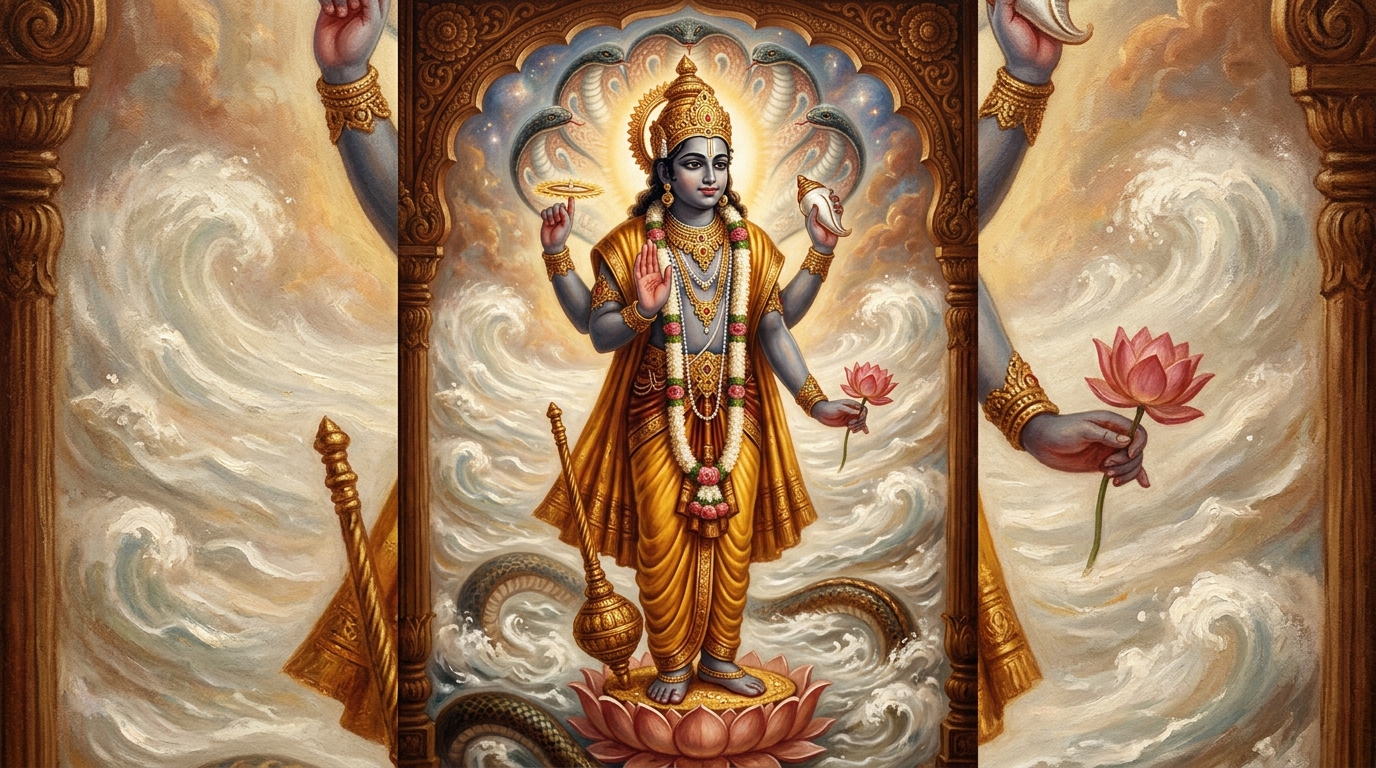
Opening with the immortal dhyana shloka "Shantakaram Bhujagashayanam", Shri Vishnu Stotra is a concise, widely revered 6-shloka hymn meditating upon the serene, cosmic, cloud-complexioned form of Lord Vishnu who dispels worldly fears and sustains the universe.
5 mins chanting
6 Shlokas
Sanskrit Shlokas & Meter
Text review in progress
Opening with the immortal dhyana shloka "Shantakaram Bhujagashayanam", Shri Vishnu Stotra is a concise, widely revered 6-shloka hymn meditating upon the serene, cosmic, cloud-complexioned form of Lord Vishnu who dispels worldly fears and sustains the universe.
Devotional Notice:
This sacred Stotram is presented for sincere devotional recitation, contemplation, and study from attested recensions with accurate Sanskrit shlokas and verse-by-verse bilingual meanings. Recitation customs vary across traditional lineages. Avhigat Akhara presents authentic textual editions without any claims of supernatural guarantees, financial windfalls, or commercialized promises; true spiritual peace arises from selfless devotion (Bhakti) and inner discipline (Sadhana).
Hindi Meaning:
जिनका स्वरूप शांत है, जो शेषनाग की शय्या पर शयन करते हैं, जिनकी नाभि से कमल प्रस्फुटित है, जो देवताओं के स्वामी हैं, जो संपूर्ण विश्व के आधार हैं, आकाश सदृश सर्वव्यापी हैं, नील मेघ के समान जिनका श्याम वर्ण है, जिनके अंग परम सुंदर व शुभ हैं, जो लक्ष्मी के प्रियकांत हैं, कमलनयन हैं, योगीजन जिन्हें ध्यान द्वारा प्राप्त करते हैं—संसार के जन्म-मरण रूपी भय को हरने वाले, समस्त लोकों के एकमात्र स्वामी उन भगवान विष्णु की मैं वंदना करता हूँ।
English Meaning:
I bow to Lord Vishnu, whose form is peaceful stillness, who rests upon the serpent Ananta, from whose navel springs the cosmic lotus, the supreme Lord of the devas, the foundation of the universe, all-pervading as the sky, dark-complexioned as a monsoon cloud, possessing auspicious limbs, the beloved Consort of Lakshmi, lotus-eyed, attainable by yogis in deep meditation, the remover of the fear of worldly existence, the one sovereign Master of all the worlds.
The celebrated universal meditation shloka outlining the ten divine attributes of the cosmic Preserver.
Shloka 2: Mangalam Bhagwan Vishnu
#2 / 6
मङ्गलं भगवान् विष्णुर्मङ्गलं गरुडध्वजः ।
मङ्गलं पुण्डरीकाक्षो मङ्गलायतनो हरिः ॥ २ ॥
Hindi Meaning:
भगवान विष्णु स्वयं मंगल स्वरूप हैं, गरुड़ध्वज श्रीहरि मंगलकारी हैं, कमलनयन पुंडरीकाक्ष मंगलमय हैं, और समस्त मंगलों के परम आधार भगवान हरि मंगल हैं।
English Meaning:
Auspicious is Lord Vishnu; auspicious is He who bears Garuda upon His flag; auspicious is the Lotus-eyed Lord; the ultimate sanctuary of all auspiciousness is Lord Hari.
The universal Sanatana invocation chanted at the commencement of sacred rituals to invoke divine auspiciousness.
Hindi Meaning:
जिनके मात्र स्मरण करने से मनुष्य जन्म-मरण रूपी संसार के बंधनों से विमुक्त हो जाता है, उन सर्वसमर्थ, अनंत प्रभावशाली भगवान विष्णु को मेरा नमस्कार है।
English Meaning:
By mere remembrance of whom a soul is liberated from the shackles of worldly rebirth, unto that all-powerful, supreme Lord Vishnu I bow in reverence.
Affirms the liberating efficacy of conscious remembrance of the divine name.
Shloka 4: Vanmali Gadi Sharngi
#4 / 6
वनमाली गदी शार्ङ्गी शङ्खी चक्री च नन्दकी ।
श्रीमान् नारायणो विष्णुर्रासुदेवोऽभिरक्षतु ॥ ४ ॥
Hindi Meaning:
वैजयंती वनमाला धारण करने वाले, कौमोदकी गदा, शार्ङ्ग धनुष, पांचजन्य शंख, सुदर्शन चक्र तथा नंदक खड्ग से सुशोभित, वे श्रीमान नारायण, सर्वव्यापी विष्णु, वासुदेव हमारी सब ओर से रक्षा करें।
English Meaning:
Adorned with the forest garland of wild blossoms (Vanamala), wielding the mace, the Sharnga bow, the conch Panchajanya, the discus Sudarshana, and the sword Nandaka—may that glorious Narayana, the all-pervading Vishnu, Vasudeva, protect us on all sides.
Invocates the protective armor of Lord Vishnu's five sacred implements and cosmic garland.
Shloka 5: Complete Self-Surrender
#5 / 6
कायेन वाचा मनसेन्द्रियैर्वा
बुद्ध्यात्मना वा प्रकृतेः स्वभावात् ।
करोमि यद्यत्सकलं परस्मै
नारायणायेति समर्पयामि ॥ ५ ॥
Hindi Meaning:
शरीर से, वाणी से, मन से, इंद्रियों से, बुद्धि से, अंतःकरण से अथवा अपनी प्रकृति के स्वभाव से मैं जो-जो भी कर्म करता हूँ, वह सब कुछ परमपुरुष श्रीमन नारायण के चरणों में समर्पित करता हूँ।
English Meaning:
Whatever actions I perform with my body, speech, mind, senses, intellect, soul, or through the natural promptings of my nature—I surrender all of it at the sacred feet of the supreme Lord Narayana.
The ultimate prayer of dedicated self-surrender (Atma-Samarpana) dissolving the ego by offering all daily actions to God.
Shloka 6: The Lotus Feet of Hari
#6 / 6
नमो ब्रह्मण्यदेवाय गोब्राह्मणहिताय च ।
जगद्धिताय कृष्णाय गोविन्दाय नमो नमः ॥ ६ ॥
Namo brahmaṇyadevāya gobrāhmaṇahitāya ca |
Jagaddhitāya kṛṣṇāya govindāya namo namaḥ || 6 ||
Hindi Meaning:
ब्रह्मनिष्ठों के पूज्य देव को प्रणाम, गौ और ब्राह्मणों का कल्याण करने वाले, संपूर्ण जगत का हित साधने वाले भगवान श्रीकृष्ण, गोविंद को मेरा बारंबार नमस्कार है। ॐ नमो भगवते वासुदेवाय।
English Meaning:
Salutations to the divine Lord of spiritual seekers, the protector of the gentle and wise, the benefactor of the entire cosmos—unto Sri Krishna, Govinda, I bow down repeatedly. Om Namo Bhagavate Vasudevaya.
The concluding universal peace salutation to Lord Krishna, the guardian of cosmic welfare.
Recited during morning meditation, Sandhya, or before opening sacred scriptures, with folded hands and focused breath.
Spiritual Significance:
Cultivates deep inner stillness (shanti), dissolves existential restlessness, and inspires selfless surrender (sharanaagati) at the lotus feet of the Preserver of the cosmos.
Phala-Shruti (Spiritual Fruits):
Bestows spiritual peace, removes fear of mortality, and fosters auspiciousness in the household.
This text is still being reviewed by the Akhara. If you see a mistake, please tell us.
॥ Authoritative Shastric Guidance ॥
Classical Context & Seekers Questions
Authoritative answers, ritual disciplines, and scriptural citations for sincere practitioners.
Q1
Theological
Vaishnava / Ramanandi
What do the four emblems held in Lord Vishnu's four arms signify?
Context Note:
Context for "Shantakaram Bhujagashayanam Padmanabham Suresham".
Summary Answer
The Shankha (Panchajanya) represents cosmic sound (AUM); the Sudarshana Chakra represents cosmic mind and the cycle of time; the Kaumodaki Gada represents intellect and cosmic law; and the Padma (Lotus) represents spiritual unfolding and purity.
The Vishnu Purana explains the cosmic metaphysics behind the Chaturbhuja (four-armed) form: The Conch creates the primordial vibration from which space and matter expand. The Discus cuts through the illusion of maya and destroys adharmic forces with the speed of pure thought. The Mace crushes ignorance and enforces divine order. The Lotus blossoming untouched above muddy water reminds the seeker to live in the world with spotless purity and selfless devotion.
Avhigat Akhara is a registered trust managed directly by sadhus. We do not hire private fundraising agencies. Donations are used for daily meals, cow care, Gurukul students and daily yajna.