
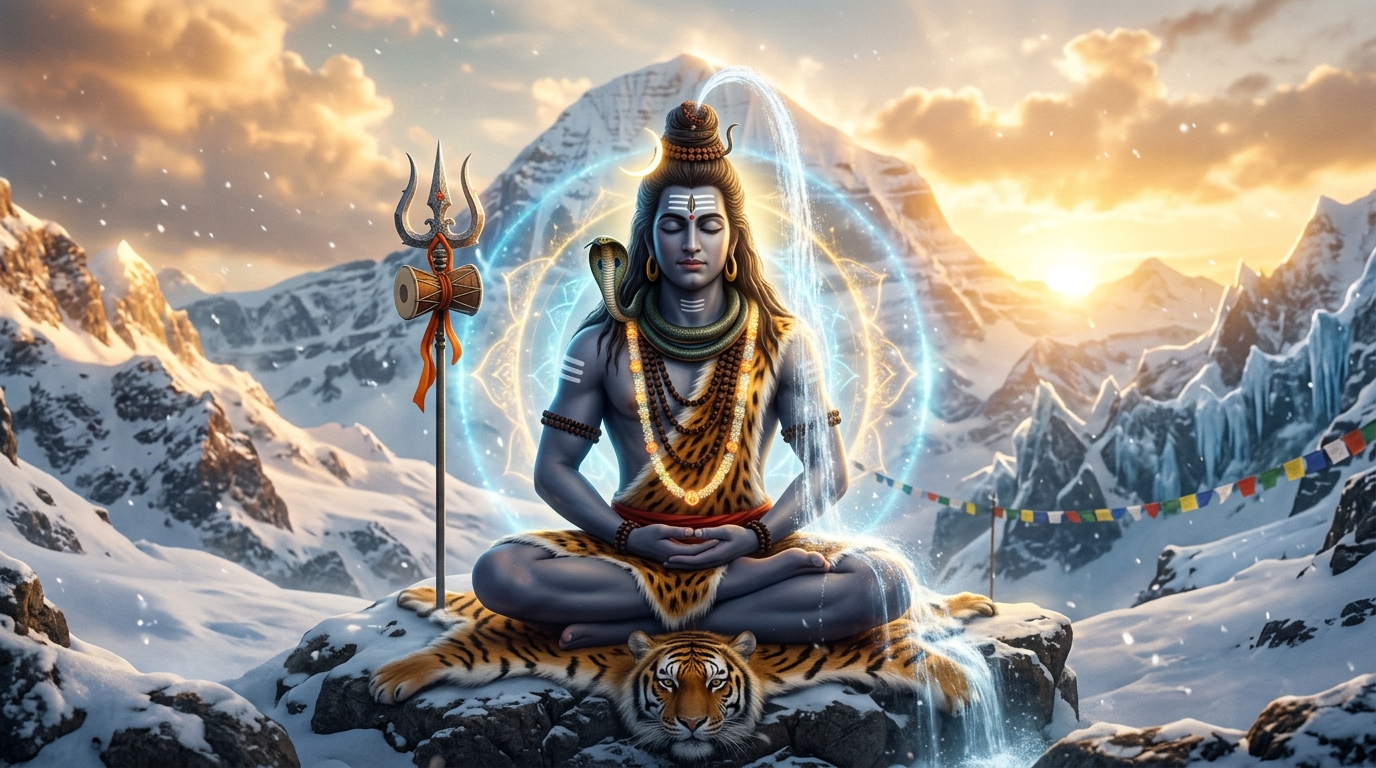
Lord Shiva
Understanding Lord Shiva in Hindu Traditions
He resides in supreme simplicity upon Mount Kailash, immersed in unmoving dhyana (meditation). For spiritual seekers and householders alike, worshipping Shiva does not require elaborate worldly wealth; a sincere heart, a pot of clean water, and bilva leaves are revered as the highest offerings.
His grace is accessible to every seeker who approaches Him with humility, truthfulness, and detachment from ego.
In classical Sanatana Dharma and Shaiva philosophies, Shiva represents pure unconditioned consciousness (Chaitanya), the silent witness of the universe, and the eternal principle of renewal through dissolution. In the Smarta tradition, He is worshipped as one of the five primary Panchayatana forms.
Sacred Iconography & Symbolic Meaning
Approved Sacred Texts & Prayers for Lord Shiva
Authoritative, canonical scriptures and prayers dedicated to Lord Shiva. Each text links to its dedicated reader with authentic Devanagari verses, transliteration, and simple meanings.
Chalisa
1Aarti
1Shri Shiv Aarti (Om Jai Shiv Omkara)
Stotra & Stotram
2Shri Shiva Tandava Stotram (Complete 16 Shlokas)
Shri Shiva Panchakshara Stotram (Complete 6 Shlokas)
Namavali
1Shri Shiva 108 Ashtottara Shata Namavali
Mantra Sangrah
1Mahamrityunjaya Mantra (Tryambakam Mantra — Rigveda 7.59.12)
Vrat, Puja & Festivals
1Maha Shivaratri (The Great Night of Lord Shiva — Worship & Awakening)
Related Sadhana & Spiritual Upasana
Sacred Observances, Fasts & Festivals
Annual & Monthly Sacred Days
Scriptural Sources, Review & Governance
- Shiva Purana — Gita Press Gorakhpur (Code 108) (Vidyeshvara & Rudra Samhitas)
- Taittiriya Samhita (Shri Rudram) — Krishna Yajurveda, Kanda 4, Prapathaka 5 (Namakam & Chamakam)
- Rigveda Samhita — Mandala 7, Sukta 59, Richa 12 (Mahamrityunjaya Mantra)
Classical Context & Seekers Questions
Authoritative answers, ritual disciplines, and scriptural citations for sincere practitioners.
Q1
What is the Vedic origin and significance of the Mahamrityunjaya Mantra?
The Mahamrityunjaya Mantra originates in the Rigveda (7.59.12) revealed by Rishi Vasishtha. It petitions Lord Shiva as Tryambaka (the Three-Eyed One) to liberate the seeker from death and ignorance like a ripe cucumber detaches effortlessly from its vine.
Mandala 7, Sukta 59 • Richa 12
Bhandarkar Oriental Research Institute, Pune
Kotirudra Samhita, Adhyaya 38 • Shlokas 14-25
Gita Press, Gorakhpur
Q2
Why are trifoliate Bilva leaves (Belpatra) dear to Lord Shiva?
The three leaflets of the Bilva leaf represent the three Gunas (Sattva, Rajas, Tamas), the three eyes of Shiva, and the Trishula. Offering unbroken trifoliate Bilva symbolizes surrendering all three Gunas and ego at Shiva's feet.
Kedara Khanda, Bilva Mahatmya • Adhyaya 22, Shlokas 1-28
Gita Press, Gorakhpur
Patrapuja Vidhi • Section 4
Chowkhamba Sanskrit Series, Varanasi
Q3
Who composed the Shiva Tandava Stotram and in which poetic metre is it written?
The Shiva Tandava Stotram was composed by Ravana, the king of Lanka, while trapped beneath Mount Kailash. It is set in the vigorous and rhythmic Panchachamara metre (पञ्चचामर छन्द).
Sarga 16, Kailashottolana Prasanga • Shlokas 25-42
Gita Press, Gorakhpur
Adhyaya 33 • Shlokas 12-30
Gita Press, Gorakhpur
Q4
What is the significance of the four Prahara pujas performed during Maha Shivaratri night?
The four night watches (Prahars) of Maha Shivaratri correspond to the gradual cleansing of the four inner faculties (Antahkarana: Manas, Buddhi, Chitta, Ahamkara) through milk, curd, ghee, and honey abhishekas.
Kotirudra Samhita, Adhyaya 37-40 • Shivaratri Vrata Mahatmya
Gita Press, Gorakhpur