Avhigat Akhara
Traditional Ascetic Hermitage & Vedic Lineage
Preserving Eternal Sanatan Dharma and Divine Guru Parampara
Membership Contact Us
Devi & Mahavidya Sadhana › Shakti Upasana

Kali Tantra Sadhana — Mastery of Time, Annihilation of Ego & Supreme Compassion

Kali Tantra Sadhana is the deep contemplative science of confronting time, mortality, and the false ego through the fierce, loving grace of Maa Kali. The word Kali is the feminine form of Kala, meaning time and eternity. In classical Sanatan metaphysics, everything that is born in time must eventually be swallowed by time. Maa Kali is the supreme conscious reality that remains when all names, forms, and universes are dissolved back into the primordial void. Popular culture often misinterprets her dark complexion, lolling tongue, and garland of severed heads as gruesome horrors meant for destructive witchcraft. Avhigat Akhara firmly dispels these shallow misconceptions. In authentic Shakta tradition, Kali is the supreme Karunamayi Mata — the deeply compassionate mother whose sword cuts off the foolish pride of the ego to liberate her children from suffering. Her dark color represents the infinite, unmanifest space of pure awareness. This sadhana trains the seeker to look fear in the face, overcome the terror of death, and realize the immortal Atman within.

Level: Beginner
Vedic
Guru Diksha Required
Kali Tantra Sadhana
Sacred Deity Sanctum Darshan Consecrated Murti
Divine Origin & Spiritual Identity

The Metaphysical Reality of Maa Kali in Tantric Lore

Transcending Time, Dissolving the Ego & Awakening Supreme Awareness
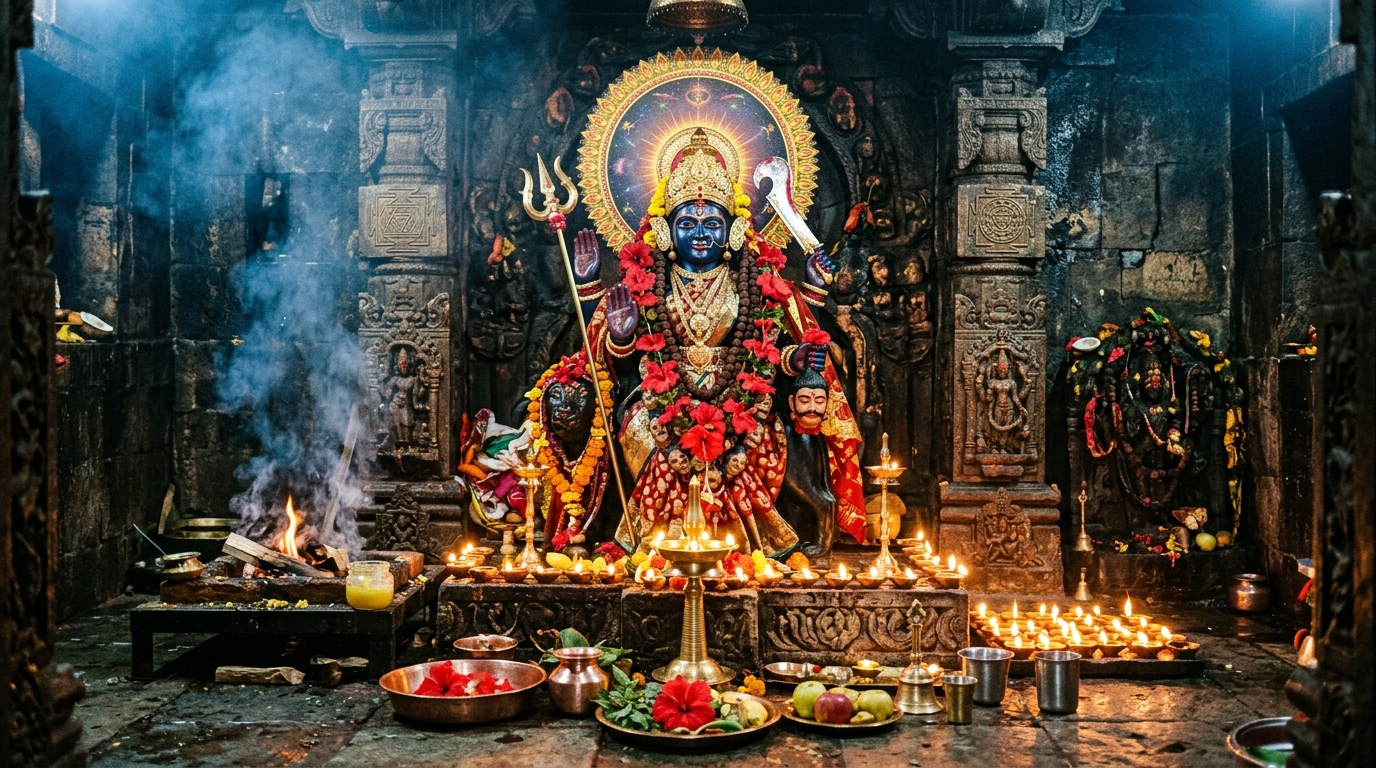
In classical Shakta scriptures such as the Kali Tantra, Karpuradi Stotra, and Mahanirvana Tantra, Maa Kali stands as the supreme non-dual reality (Adyashakti). She is depicted standing upon the chest of Lord Shiva, who lies motionless like a white corpse (Shava). In Tantric symbolism, Shiva represents pure, unmanifest consciousness (Prakasha), while Kali represents dynamic, self-aware creative power (Vimarsha). Without her movement, consciousness cannot experience itself; hence the famous saying: Shiva without Shakti is Shava (lifeless). Her dark hue, resembling a midnight monsoon cloud, signifies that all colors and forms dissolve into darkness, just as all finite thoughts dissolve into the infinite silence of Samadhi. The garland of fifty severed heads around her neck is the garland of the Sanskrit alphabet (Varnamala), representing the dissolution of human language, conceptual ideas, and rigid dogmas. Her lolling tongue indicates the control of the Rajasic gunas through Sattva, catching the blood of the demon Raktabija — an allegory for stopping the endless reproduction of restless, greedy desires in the mind. When an authentic seeker undertakes Kali Tantra, there is no place for pride, deceit, or personal entitlement. The seeker surrenders all worldly identities at the lotus feet of the Mother. Under her fierce gaze, the petty anxieties of daily life — fear of sickness, loss of reputation, and mortal death — lose all power to disturb the soul. The practitioner realizes that the true Self was never born and can never die. In our akhara monastic history, this realization was compared to stepping out of a dark prison into the bright sunlight. When the seeker ceases to identify with the perishable body of flesh and bones, the dread of physical mortality dissolves instantly, replaced by a radiant awareness of eternity that makes the seeker completely fearless in the defense of dharma.
The Metaphysical Reality of Maa Kali in Tantric Lore
Kali Tantra Sadhana
Sanctum Sacred Representation
Conquest of Mortal Fear (Kala Bhaya)
Destruction of the False Ego
Awakening of Deep Compassion
Pure Non-Dual Awareness
Definition & Spiritual Essence

What is Kali Tantra Sadhana?

Sacred essence, spiritual foundation, and scriptural truth

Authoritative Summary (Direct Essence)

Kali Tantra Sadhana is the deep contemplative science of confronting time, mortality, and the false ego through the fierce, loving grace of Maa Kali. The word Kali is the feminine form of Kala, meaning time and eternity. In classical Sanatan metaphysics, everything that is born in time must eventually be swallowed by time. Maa Kali is the supreme conscious reality that remains when all names, forms, and universes are dissolved back into the primordial void. Popular culture often misinterprets her dark complexion, lolling tongue, and garland of severed heads as gruesome horrors meant for destructive witchcraft. Avhigat Akhara firmly dispels these shallow misconceptions. In authentic Shakta tradition, Kali is the supreme Karunamayi Mata — the deeply compassionate mother whose sword cuts off the foolish pride of the ego to liberate her children from suffering. Her dark color represents the infinite, unmanifest space of pure awareness. This sadhana trains the seeker to look fear in the face, overcome the terror of death, and realize the immortal Atman within.

Kali Tantra Sadhana is treated in Avhigat Akhara with the utmost solemnity, respect, and scholarly accuracy. Modern pulps have filled the public imagination with horrific ideas that Kali worship requires midnight visits to burning grounds, human flesh, and demonic curses. The Acharyas of our akhara fiercely condemn these grotesque lies as poisonous fabrications of charlatans. In our lineage, Kali sadhana is a path of absolute love, ethical transparency, and fearless introspection. The practitioner prepares by establishing a spotless meditation space in the quiet of the home. Before dawn, after a cleansing bath, the seeker sits on a black or red woolen asana facing East. A brass diya of pure sesame oil or mustard oil is lit, creating a steady golden flame. The seeker offers red flowers and a single piece of dark jaggery to the Mother, recognizing her presence as the warm fire of digestion and the life breath within the body. Holding a sanctified rosary of rudraksha beads, the practitioner recites the sacred Kali mantra in a low, resonant murmur. With every repetition, the seeker visualizes the Mother holding her sword above the head, slicing through mental confusion, jealousy, and self-doubt. The mind is gently guided back into the heart center, resting in the peaceful black void where no pain or trouble can enter. Sincere practitioners report that after a few weeks of this anushthan, their chronic anxiety and night terrors disappear completely. The personality becomes steady, grounded, and fearless, radiating an aura of calm authority that calms disputes and brings order to troubled households. In addition, practitioners find that they no longer feel intimidated by aggressive worldly personalities or corrupt social pressures. Because they have surrendered to the supreme mistress of time, earthly titles and arrogant threats appear entirely hollow and powerless to disturb their inner peace.
Spiritual Purpose & Inner Evolution

Why is Kali Tantra Sadhana Practiced?

Core spiritual purposes, inner purification, and consciousness evolution

Mental Stillness & Focus

Daily japa and meditative contemplation calm wandering thoughts, fostering sharp inward awareness and emotional balance.

Spiritual Fortitude & Energy Balance

Authentic sacred kavacha and nyasa practices protect subtle vitality from negative inclinations, fear, and distraction.

Cultivation of Sattvic Discernment

Helps dissolve pride, resentment, and restlessness, strengthening humility, discernment, and spiritual surrender.

Inner Realization & Lineage Grace

Not an outward exhibition, but an inward journey toward self-realization sheltered under authentic monastic lineage guidance.

Tattvik Insight & Philosophy

Spiritual Significance & Philosophy

Philosophical essence and the science of internal transformation

“The essential significance of Kali Tantra Sadhana is the psychological conquest of darkness. Most people spend their lives fleeing from uncomfortable truths — running from their own shadows, burying their sorrows, and pretending to be happy. Maa Kali forces the seeker to look into the darkness and discover that darkness is simply the unmanifest presence of the Divine Mother. When fear is embraced with devotion, it ceases to terrify. The seeker walks through life with majestic freedom, loving without needing to possess and living without the dread of loss. In our lineage teachings, this state of fearlessness is regarded as the highest practical fruit of Vedanta. When the practitioner realizes that Maa Kali is the loving mother who will receive the soul at the hour of death, death itself becomes a welcoming transition into divine peace rather than a terrifying calamity.”
Avhigat Akhara Monastic Wisdom
Seeker Eligibility & Suitability

Who is This Sadhana For?

Eligibility criteria, seeker temperament, and prerequisite guidance

Sincere Seekers

Individuals seeking daily focus, spiritual discipline, and quiet inward balance without complex rituals.

Householders

Practitioners balancing work, family, and social obligations while following a pure satvik spiritual path.

Disciplined Initiates

Dedicated practitioners who have mastered basic disciplines and wish to undertake formal anusthana under Guru Diksha.

Importance of Lineage Grace & Approval

Tantrik, Mahavidya, and advanced dhyana disciplines should not be initiated whimsically without lineage permission and proper understanding.

Seeker Discretion Notice

Who Should Take Lineage Guidance First?

Lineage Principle: Practice preserves sanctity and protects seekers when guided authentically

CRITICAL SAFETY WARNING: Do not perform any midnight rituals in cemeteries, do not consume intoxicants, and do not attempt fierce Tantric curses. Such perverse actions invite severe psychological disorders, hallucinations, and catastrophic life failures. In Avhigat Akhara, Kali worship is performed in daylight or early dawn with complete sobriety, offering only jaggery, flowers, and pure water. If you feel sudden heat or emotional agitation during practice, pause your recitation, drink cold milk, and chant Om Namah Shivaya.
Request Lineage Guidance Consultation Avhigat Akhara upholds the sacred decorum of traditional Diksha and guided practice.
Origins, Tradition & Guru Parampara

Historical Origins & Guru Parampara

Authentic scriptural foundation and unbroken monastic transmission

Traditional Origins

The roots of Kali appear in the Rigvedic hymn to Ratri (Night) and the Mundaka Upanishad, where Kali is named as one of the seven tongues of the sacred fire. Her full mythological narrative unfolds in the Devi Mahatmya of the Markandeya Purana, where she emerges from the forehead of Durga to destroy the demons Chanda, Munda, and Raktabija. Medieval texts like the Kali Tantra, Mahakala Samhita, and the songs of Ramprasad Sen and Ramakrishna Paramahamsa elevated her worship to the heights of non-dual devotion. Avhigat Akhara maintains this pure, devotional Vedantic-Tantric synthesis. In our ashram chronicles, great masters taught that Kali fierce form is simply the mirror that reveals our own hidden attachments; when we love the Mother without fear, her terrible appearance transforms into an ocean of sweet compassion.

Scriptural Authority

Referenced in Devi Mahatmya (Durga Saptashati, Chapters 7-8), Kali Tantra, Karpuradi Stotra, Mahanirvana Tantra, and the Todala Tantra. These texts declare that Kali is the easiest path to liberation in the age of Kali Yuga because she directly cuts through intellectual pretension.

Monastic Lineage Shelter

Maintained in Avhigat Akhara under supervised Shakta initiation protocols. The name Kaali Tantra is flagged for spelling standardization to Kali Tantra Sadhana while preserving the original record name in the administrative archives.
Pujya Guru Ji Maharaj - Avhigat Akhara
Guidance by Pujya Guru Ji Maharaj
“The child is never afraid of its mother, even when she holds a stick. Maa Kali is fierce only to your ego; to your soul, she is softer than a lotus petal.”

The Guru teaches that seeking power from Kali to harm an enemy is like using the sun fire to burn dry grass. True worship is to surrender your own anger, greed, and vanity at her feet. When you become empty of ego, she fills your heart with immortal light.

Preparation & Sacred Disciplines

Preparation & Sacred Disciplines

Essential guidelines, satvik habits, and sanctum preparations

01

Purification of Water

Recommended

Place a brass or copper bowl of fresh spring water before you, offering a silent chant of purification.

02

Lighting the Sacred Flame

Recommended

Light a pure brass lamp filled with mustard oil or sesame oil, bowing to the fire as the witness of your vow.

03

Offering the Red Hibiscus

Recommended

Place a fresh red hibiscus flower before the image of Maa Kali with sincere, humble devotion.

04

Pranic Grounding

Recommended

Take ten slow, deep breaths through the nose, feeling the body anchor itself to the earth in complete peace.

05

Sword of Discernment Focus

Recommended

Visualize the radiant sword of divine wisdom resting gently above your heart, ready to sever all negative thoughts.

Practice Progression & Stages

Practice Progression & Stages

Systematic pathway from preliminary understanding to final sanctum offering

01

Bhaya Nashana (Fear Annihilation)

Deep-seated phobias, social panic, and irrational anxiety about death dissolve under steady japa.

02

Ahamkara Tyaga (Ego Surrender)

The urge to dominate, argue, and boast disappears, replaced by genuine humility and quiet inner dignity.

03

Karuna Prakasha (Compassionate Radiance)

The heart fills with an overpowering affection for all living beings, wishing freedom from pain for everyone.

04

Kala Jayi (Time Transcendence)

The seeker realizes the immortal nature of the soul, living in undisturbed peace beyond the reach of time.

Daily Practice Discipline & Niyama

Daily Practice Discipline & Routine

Sanctum steadfastness: One Time, One Altar, and Inner Purity

Rule
Recommended

Vow of Non-Anger (Akrodha)

Rule
Recommended

Fearless Truthfulness

Rule
Recommended

Strict Sobriety

Rule
Recommended

Reverence for the Transitory

Rule
Recommended

Daily Offering of Jaggery

Rule
Recommended

Loving Compassion

Rule
Recommended

Deep Night Silence

Rule
Recommended

Mental Surrender

Sacred Cautions & Safety Guidelines

Common Mistakes & Sacred Cautions

Safeguarding seekers against mispronunciation, haste, and unauthorized practices

Chanting Kali mantras with angry, hateful, or revengeful thoughts.

Correct Lineage Guidance: Recite solely with the loving devotion of a child; hatred poisons the caller spirit.

Performing rituals in dirty clothes or in messy, chaotic rooms.

Correct Lineage Guidance: Maintain spotless bodily cleanliness and a tidy, quiet, and well-aired sanctuary.

Listening to scary online videos about graveyard curses.

Correct Lineage Guidance: Fill your mind with the noble teachings of Ramakrishna Paramahamsa and authentic scriptures.

Neglecting your daily family or professional obligations.

Correct Lineage Guidance: Fulfill all duties with cheerfulness; true Kali sadhana makes you a better parent and worker.

Authentic Seeker Inquiries

Authentic Questions Asked by Seekers

Direct, practical answers grounded in verified tradition and authentic lineage wisdom

Why does Maa Kali stand upon Lord Shiva?
Shiva represents static consciousness, while Kali represents active dynamic power. In spiritual physics, without energy, consciousness cannot express itself. She also steps upon him to remember her own calm nature.
Is it safe to keep a picture of Maa Kali at home?
Yes. The traditional four-armed Dakshina Kali, standing with a blessing hand, is the protective mother of the home, removing negativity, evil eyes, and fear.
Can women chant Kali mantras during their monthly cycle?
Mental japa (Manasik Japa) can be practiced at all times without restriction. Physical rituals may be paused if there is fatigue.
What is the difference between Durga and Kali?
Durga is the protective mother who upholds cosmic order and destroys external demons. Kali is the inner force that directly destroys the subtle internal ego and conquers time itself.
Frequently Asked Questions

Frequently Asked Questions

Authentic answers to common queries regarding initiation, timing, and practice

Pure mustard oil (Sarson ka tel) or sesame oil (Til ka tel) is traditionally used for Kali upasana.

YOUR SACRED NEXT STEP

Ready to Begin Kali Tantra Sadhana?

Follow the authentic Vedic and monastic path under lineage guidance before starting your practice.

Guidance Recommended

Guru Guidance & Diksha Consultation

This sacred practice requires initiation and protective mantra guidance from the authentic monastic lineage before regular practice.

Direct connection with Avhigat Akhara.
Enquiry Open

Kali Tantra Sadhana Guided Training

Learn step-by-step mantra japa, mudras, and nyasa under authentic Acharyas through our guided monastic batches.

Batch curriculum and registration dates announced periodically.
Approved Paraphernalia

Kali Tantra Sadhana Sacred Essentials

View consecrated Jap Malas, consecrated Yantras, Kusha asanas, and authentic sadhana kits approved by Avhigat Akhara.

Consecrated items energized per scriptural traditions.
View Sadhana Essentials
Sacred Sanctum Essentials

Sacred Essentials & Sanctum Items

Consecrated items traditionally used to support meditation, focus, and sanctum discipline

Tradition & Guidance Advisory

Use of Mala, Yantra, Kit or other materials can vary by practice. Follow the guidance given for your Sadhana.

Essential Checklist Before Practice
Vedic Sequence
1
1. Guidance
Guru Guidance
Consult
2
2. Mala
Consecrated Mala
View ↓
3
3. Yantra
Sanctum Yantra
View ↓
4
4. Kit
Sadhana Kit
View ↓
5
5. Asan
Pure Woolen Asan
View ↓
Mala Sacred Tool

Consecrated Haldi / Tulsi Japa Mala

108 knotted beads consecrated according to Vedic rites.

Yantra Sanctum Item

Handcrafted Copper Yantra Plate

Sacred geometric plate for sanctum meditation and focus.

Asan Daily Practice

Pure Woolen Meditation Asana

Traditional insulation mat to preserve spiritual energy.

॥ श्री गुरु चरण सरोज रज ॥

One-to-One Samasya Samadhan

Confidential Guidance

Private guidance from Guru Ji and the Akhara's guides. Choose what you need help with.