Avhigat Akhara
Traditional Ascetic Hermitage & Vedic Lineage
Preserving Eternal Sanatan Dharma and Divine Guru Parampara
Membership Contact Us
Diksha, Sannyas & Marg Disciplines › Monastic Diksha Disciplines

Tantrik Guru Pujan Sadhana — The Sacred Anchor of Lineage Transmission

Tantrik Guru Pujan Sadhana is the foundational and indispensable gateway to all esoteric practices in Sanatan Dharma. In the classical Agamas, it is declared with uncompromising clarity that without the grace, guidance, and protective shield of the living Guru, all mantras remain dormant letters and all rituals are sterile ceremonies. The Guru is not merely a human teacher of academic information; the Guru is the living embodiment of the unbroken transmission stream (Ogha) connecting the individual seeker back to Lord Shiva, the primordial preceptor (Adinatha). Tantrik Guru Pujan is the contemplative science of surrendering the restless ego, anchoring the mind in the sacred sandals (Guru Paduka) at the crown of the head, and receiving the spiritual electricity of lineage blessing. In Avhigat Akhara, this sadhana is held as the supreme safeguard that prevents spiritual pride, grounds explosive energies, and guarantees that the seeker journey leads to true self-realization rather than psychological ruin.

Level: Beginner
Vedic
Guru Diksha Required
Tantrik Guru Pujan Sadhana
Sacred Deity Sanctum Darshan Consecrated Murti
Divine Origin & Spiritual Identity

The Cosmic Doctrine of the Guru Tattva in Tantra

The Living Bridge Between Finite Seeker & Infinite Shiva
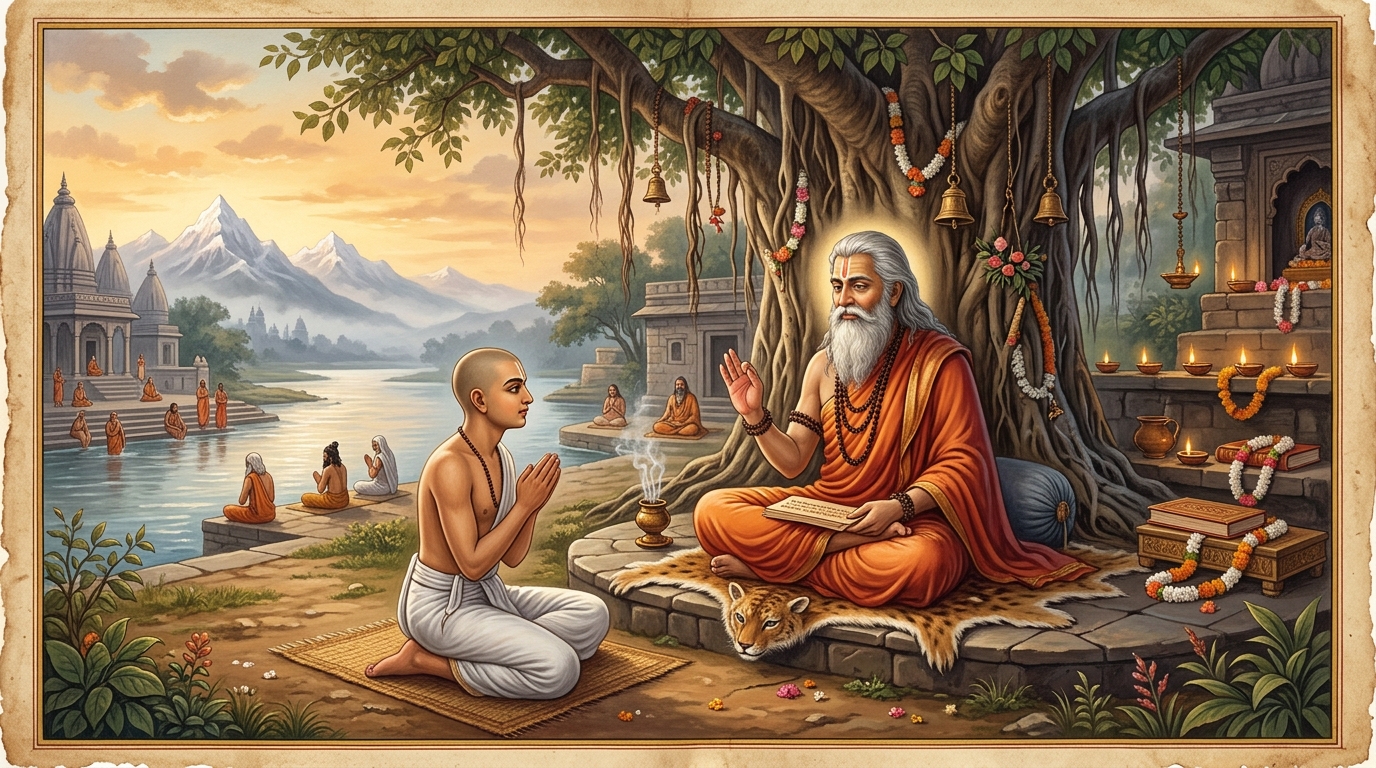
In classical Tantric literature, such as the Guru Gita, the Kularnava Tantra, and the Yogini Hridaya, the Guru is revered as the non-dual manifestation of the Supreme Absolute. The famous verse Gurur Brahma Gurur Vishnur Gurur Devo Maheshvarah expresses a literal metaphysical truth: the Guru creates the new spiritual birth of the disciple (Brahma), sustains and protects the fragile flame of practice through life challenges (Vishnu), and destroys the deep-rooted karmic ignorance of the ego (Maheshvara). In the internal anatomy of the yogi, the Guru dwells in the thousand-petaled lotus at the crown of the head (Sahasrara Chakra), seated upon a radiant white lotus in the cool sphere of the full moon. Meditating upon the Guru Paduka (sacred sandals) in the crown chakra cools the intense heat generated by lower chakra sadhanas and opens the central Sushumna channel for peaceful ascension. The Agamas warn that attempting advanced Tantric practices without the Guru blessing is like sailing an open boat into an ocean hurricane without a compass or rudder. The seeker who relies only on intellectual pride quickly falls into delusions of grandeur, neurotic obsessions, or severe psychological fragmentation. Through daily Guru Pujan, the student acknowledges with heartfelt humility that all spiritual progress, all peace, and all insights are gifts of the lineage rather than personal achievements. This continuous surrender dissolves the ego, keeping the seeker heart sweet, humble, and perfectly receptive to divine light. In the monastic training of Avhigat Akhara, seniors teach that the Guru Paduka serves as a lightning rod for high spiritual currents. When powerful kundalini energy awakens, it naturally moves toward the crown; if the crown is anchored in the humble love of the Guru, the energy settles into sublime samadhi rather than generating physical spasms or manic mental excitement.
The Cosmic Doctrine of the Guru Tattva in Tantra
Tantrik Guru Pujan Sadhana
Sanctum Sacred Representation
Awakening of Mantra Chaitanya
The Lineage Armor (Kavacha)
Dissolution of Intellectual Pride
Cooling the Pranic Fire
Definition & Spiritual Essence

What is Tantrik Guru Pujan Sadhana?

Sacred essence, spiritual foundation, and scriptural truth

Authoritative Summary (Direct Essence)

Tantrik Guru Pujan Sadhana is the foundational and indispensable gateway to all esoteric practices in Sanatan Dharma. In the classical Agamas, it is declared with uncompromising clarity that without the grace, guidance, and protective shield of the living Guru, all mantras remain dormant letters and all rituals are sterile ceremonies. The Guru is not merely a human teacher of academic information; the Guru is the living embodiment of the unbroken transmission stream (Ogha) connecting the individual seeker back to Lord Shiva, the primordial preceptor (Adinatha). Tantrik Guru Pujan is the contemplative science of surrendering the restless ego, anchoring the mind in the sacred sandals (Guru Paduka) at the crown of the head, and receiving the spiritual electricity of lineage blessing. In Avhigat Akhara, this sadhana is held as the supreme safeguard that prevents spiritual pride, grounds explosive energies, and guarantees that the seeker journey leads to true self-realization rather than psychological ruin.

Tantrik Guru Pujan Sadhana is the sacred daily anchor of every student and sannyasi within Avhigat Akhara. Before any other deity is invoked, before any yantra is drawn, and before any fire offering is lit, the practitioner must complete the worship of the Guru Mandala. In our ashram discipline, this pujan is a quiet, contemplative communion. In the serene morning hour, the seeker sits on a clean woolen asana facing East. On a small raised wooden altar, a consecrated photograph of the Guru or a representation of the Guru Paduka is set upon a fresh white silk cloth. A pure cow ghee lamp is lit, its golden flame symbolizing the light of wisdom that banishes the darkness of ignorance. The seeker offers fresh white flowers, fragrant white sandalwood paste, and a clean cup of spring water. Closing the eyes, the practitioner withdraws attention from the external world and visualizes the Guru seated within the lotus of the heart or at the Sahasrara Chakra above the head. With deep emotion, the seeker recites the sacred Guru Stotra, Guru Paduka Stotra, or the personal Guru mantra given at Diksha. With each syllable, the seeker mentally bows and surrenders all personal anxieties, intellectual doubts, and pride into the hands of the preceptor. Sincere practitioners experience an immediate downpouring of peace, mental clarity, and deep emotional relief. The seeker realizes that they are never alone; the master wisdom is watching over every breath. This practice ensures that no matter how complex the outer world becomes, the seeker inner sanctuary remains untouchable, peaceful, and radiant with grace. In daily professional and family life, this practice fosters an attitude of joyful responsibility. Disciples treat their workplace duties and domestic relationships as sacred seva performed for the satisfaction of the Guru, banishing boredom, cynicism, and complaints from daily work.
Spiritual Purpose & Inner Evolution

Why is Tantrik Guru Pujan Sadhana Practiced?

Core spiritual purposes, inner purification, and consciousness evolution

Mental Stillness & Focus

Daily japa and meditative contemplation calm wandering thoughts, fostering sharp inward awareness and emotional balance.

Spiritual Fortitude & Energy Balance

Authentic sacred kavacha and nyasa practices protect subtle vitality from negative inclinations, fear, and distraction.

Cultivation of Sattvic Discernment

Helps dissolve pride, resentment, and restlessness, strengthening humility, discernment, and spiritual surrender.

Inner Realization & Lineage Grace

Not an outward exhibition, but an inward journey toward self-realization sheltered under authentic monastic lineage guidance.

Tattvik Insight & Philosophy

Spiritual Significance & Philosophy

Philosophical essence and the science of internal transformation

“The ultimate significance of Tantrik Guru Pujan Sadhana is that it bridges human limitation with divine infinity. Left to individual effort alone, the human mind is trapped in its own psychological conditioning, past karmas, and blind spots. The Guru provides the objective mirror, the compassionate correction, and the energetic catalyst that lifts the soul above its own limitations. Guru Pujan transforms cold spiritual technique into a warm, living relationship of love and liberation. When modern seekers encounter confusing life trials, economic upheavals, or sudden family bereavements, the unbroken remembrance of the Guru provides an unshakeable inner citadel. The student knows that while outer circumstances come and go like clouds, the Guru guidance remains an eternal anchor that guides the soul safely home to freedom.”
Avhigat Akhara Monastic Wisdom
Seeker Eligibility & Suitability

Who is This Sadhana For?

Eligibility criteria, seeker temperament, and prerequisite guidance

Sincere Seekers

Individuals seeking daily focus, spiritual discipline, and quiet inward balance without complex rituals.

Householders

Practitioners balancing work, family, and social obligations while following a pure satvik spiritual path.

Disciplined Initiates

Dedicated practitioners who have mastered basic disciplines and wish to undertake formal anusthana under Guru Diksha.

Importance of Lineage Grace & Approval

Tantrik, Mahavidya, and advanced dhyana disciplines should not be initiated whimsically without lineage permission and proper understanding.

Seeker Discretion Notice

Who Should Take Lineage Guidance First?

Lineage Principle: Practice preserves sanctity and protects seekers when guided authentically

WARNING: Do not surrender your intellect or finances to fraudulent charlatans who demand property, encourage illegal actions, or claim to be omnipotent gods. In Sanatan tradition, an authentic Guru never exploits disciples, never asks for worldly wealth, and always directs your devotion toward the Supreme Divine and righteous conduct. If someone demands unconditional obedience while violating basic ethics, leave immediately. True Guru Pujan is directed to the universal Guru Tattva embodied in the lineage, not to a commercial personality cult.
Request Lineage Guidance Consultation Avhigat Akhara upholds the sacred decorum of traditional Diksha and guided practice.
Origins, Tradition & Guru Parampara

Historical Origins & Guru Parampara

Authentic scriptural foundation and unbroken monastic transmission

Traditional Origins

The tradition of Guru Pujan is as ancient as the Vedas, celebrated in the Shvetashvatara Upanishad (6.23) and extensively detailed in the Guru Gita section of the Skanda Purana. In Agamic and Tantric lineages, the Guru Mandala was formalized into three tiers of lineage transmission: the Divyaugha (divine stream starting from Shiva), Siddhaugha (perfected masters stream), and Manavaugha (human teachers stream). Avhigat Akhara preserves this pristine three-tiered transmission intact through centuries of oral and practical instruction. Monastic historical accounts show that whenever disciples experienced spiritual dryness or intellectual confusion during long mountain retreats, returning to one-pointed Guru Paduka contemplation immediately restored their inner fire and brought back effortless mental clarity.

Scriptural Authority

Recorded in Guru Gita (Skanda Purana), Kularnava Tantra (Ullasa 11-13 on Guru Seva), Shvetashvatara Upanishad (6.23), Yogini Hridaya, and the Tantraraja Tantra. These classical scriptures uniformly state that Guru devotion is the single greatest secret to spiritual accomplishment.

Monastic Lineage Shelter

Preserved in Avhigat Akhara as an essential daily foundation for all disciples and householders. Initiates are taught that without the Guru, no spiritual building can stand. It is published openly as an educational model of authentic, ethical devotion free from personality exploitation.
Pujya Guru Ji Maharaj - Avhigat Akhara
Guidance by Pujya Guru Ji Maharaj
“The Guru does not give you something new from outside. The Guru simply wipes the dust from your inner mirror so that you can see your own true face.”

The elders remind us that real Guru Pujan is not just offering flowers to a picture frame on the wall. Real Guru Pujan is to obey the Guru ethical teachings in your everyday life: speak the truth, harm no living being, forgive those who wrong you, and love everyone without selfish motive.

Preparation & Sacred Disciplines

Preparation & Sacred Disciplines

Essential guidelines, satvik habits, and sanctum preparations

01

Sanctifying the Altar Cloth

Recommended

Wipe the wooden altar platform clean and spread a fresh white silk or cotton cloth.

02

Placing the Guru Paduka

Recommended

Place the sacred representation of the Guru Paduka or holy picture at the center of the altar.

03

Lighting the Pure Ghee Diya

Recommended

Light a clean brass diya of pure cow ghee, greeting the flame as the light of unbroken lineage wisdom.

04

Offering White Sandalwood and Flowers

Recommended

Apply fragrant white sandalwood paste to the Paduka and offer a fresh white flower with deep reverence.

05

Internal Crown Alignment

Recommended

Close your eyes, bring attention to the crown of your head, and mentally visualize the cool feet of the Guru.

Practice Progression & Stages

Practice Progression & Stages

Systematic pathway from preliminary understanding to final sanctum offering

01

Samarpana (Surrender of Doubt)

Restless intellectual skepticism and anxiety melt away, replaced by peaceful trust in lineage guidance.

02

Sushumna Shuddhi (Channel Opening)

The central nadi cools and relaxes under crown meditation, allowing effortless upward flow of prana.

03

Ananda Lahari (Wave of Inner Bliss)

The seeker heart is flooded with quiet, steady joy that remains untroubled by external life conditions.

04

Guru-Shishya Aikya (Non-Dual Unity)

The boundary between disciple, teacher, and divine reality dissolves into seamless unity of consciousness.

Daily Practice Discipline & Niyama

Daily Practice Discipline & Routine

Sanctum steadfastness: One Time, One Altar, and Inner Purity

Rule
Recommended

Complete Humility of Spirit

Rule
Recommended

Strict Ethical Adherence

Rule
Recommended

Daily Guru Smaran

Rule
Recommended

Protection of Lineage Honor

Rule
Recommended

Selfless Ashram Seva

Rule
Recommended

Peaceful Speech

Rule
Recommended

Faith During Difficulties

Rule
Recommended

Sharing the Light of Knowledge

Sacred Cautions & Safety Guidelines

Common Mistakes & Sacred Cautions

Safeguarding seekers against mispronunciation, haste, and unauthorized practices

Treating Guru Pujan as an empty ritual without sincere emotional devotion.

Correct Lineage Guidance: Pour your heartfelt love and gratitude into every mantra; ritual without love is lifeless.

Flattering the Guru outwardly while secretly disobeying ethical instructions.

Correct Lineage Guidance: True discipleship is total honesty and obedient living, not empty flattery.

Comparing your Guru to other teachers or engaging in sectarian arguments.

Correct Lineage Guidance: Respect all enlightened masters, but remain anchored with one-pointed loyalty to your own lineage.

Believing that taking Diksha excuses you from personal discipline and hard work.

Correct Lineage Guidance: Understand that the Guru shows the path, but your own feet must walk every single step.

Authentic Seeker Inquiries

Authentic Questions Asked by Seekers

Direct, practical answers grounded in verified tradition and authentic lineage wisdom

Why is Guru Pujan performed before worshipping any other deity?
Because it is the Guru who introduces you to the deity and awakens the mantra. Without the Guru, the seeker cannot properly comprehend or sustain divine energy.
What if my Guru has passed away from the physical body?
The physical body is only a temporary instrument; the Guru Tattva is immortal and omnipresent. Meditating upon the Guru Paduka connects you directly with the master eternal presence.
What is the significance of the Guru Paduka (sandals)?
The Paduka represents the sacred contact point where divine grace touches the earth. Touching or meditating upon the Paduka grounds the seeker ego and imparts deep humility.
Can a householder achieve high realization through Guru Pujan alone?
Yes. Great saints have declared that total surrender to the Guru (Guru Bhakti) contains the fruit of all yogas, penances, and pilgrimages combined.
Frequently Asked Questions

Frequently Asked Questions

Authentic answers to common queries regarding initiation, timing, and practice

Fresh white flowers such as jasmine, white lotus, or white roses are traditional and deeply auspicious.

YOUR SACRED NEXT STEP

Ready to Begin Tantrik Guru Pujan Sadhana?

Follow the authentic Vedic and monastic path under lineage guidance before starting your practice.

Guidance Recommended

Guru Guidance & Diksha Consultation

This sacred practice requires initiation and protective mantra guidance from the authentic monastic lineage before regular practice.

Direct connection with Avhigat Akhara.
Enquiry Open

Tantrik Guru Pujan Sadhana Guided Training

Learn step-by-step mantra japa, mudras, and nyasa under authentic Acharyas through our guided monastic batches.

Batch curriculum and registration dates announced periodically.
Approved Paraphernalia

Tantrik Guru Pujan Sadhana Sacred Essentials

View consecrated Jap Malas, consecrated Yantras, Kusha asanas, and authentic sadhana kits approved by Avhigat Akhara.

Consecrated items energized per scriptural traditions.
View Sadhana Essentials
Sacred Sanctum Essentials

Sacred Essentials & Sanctum Items

Consecrated items traditionally used to support meditation, focus, and sanctum discipline

Tradition & Guidance Advisory

Use of Mala, Yantra, Kit or other materials can vary by practice. Follow the guidance given for your Sadhana.

Essential Checklist Before Practice
Vedic Sequence
1
1. Guidance
Guru Guidance
Consult
2
2. Mala
Consecrated Mala
View ↓
3
3. Yantra
Sanctum Yantra
View ↓
4
4. Kit
Sadhana Kit
View ↓
5
5. Asan
Pure Woolen Asan
View ↓
Mala Sacred Tool

Consecrated Haldi / Tulsi Japa Mala

108 knotted beads consecrated according to Vedic rites.

Yantra Sanctum Item

Handcrafted Copper Yantra Plate

Sacred geometric plate for sanctum meditation and focus.

Asan Daily Practice

Pure Woolen Meditation Asana

Traditional insulation mat to preserve spiritual energy.

॥ श्री गुरु चरण सरोज रज ॥

One-to-One Samasya Samadhan

Confidential Guidance

Private guidance from Guru Ji and the Akhara's guides. Choose what you need help with.