
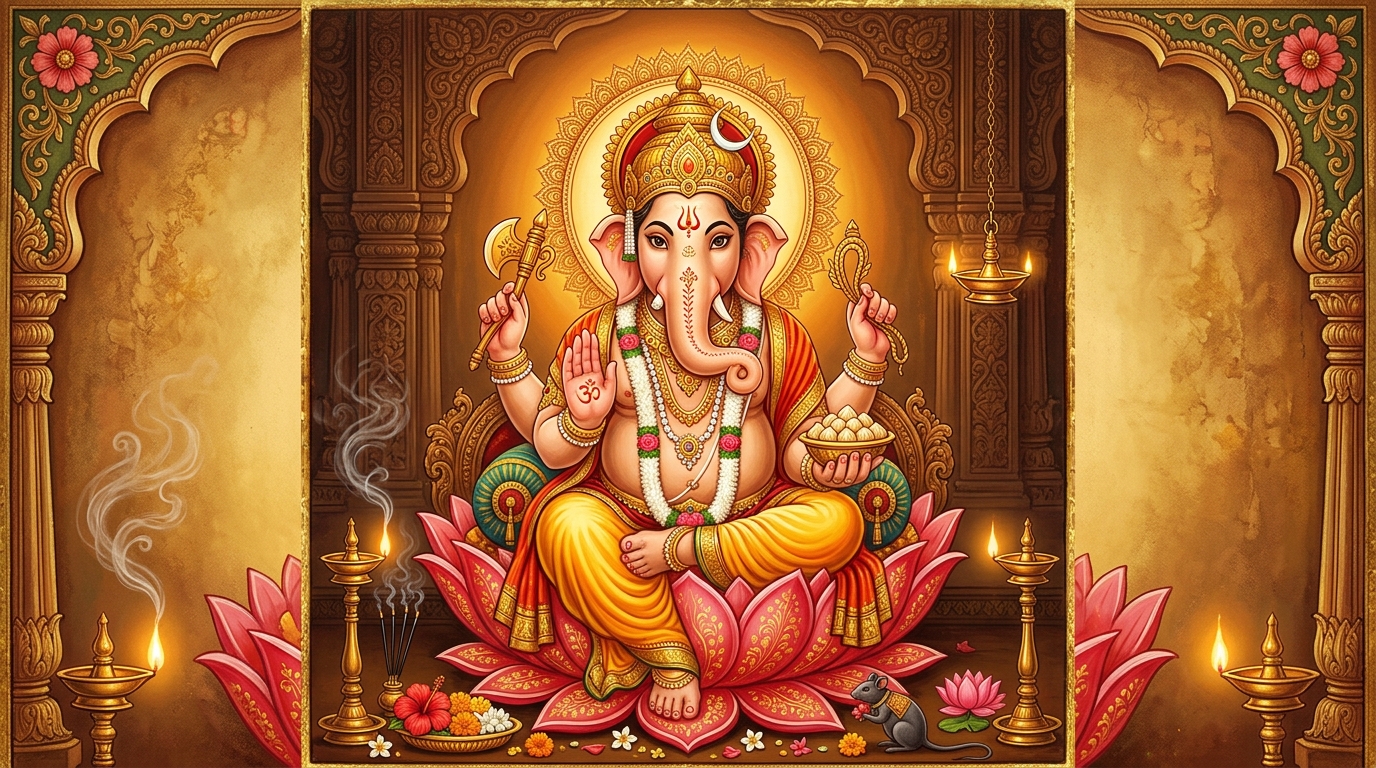
Lord Ganesha is the embodied personification of Pranava (the primordial sacred syllable Om). In yogic anatomy, Ganesha presides over the Muladhara Chakra (the root energy vortex), which grounds the seeker’s consciousness in stability, patience, and purity before the Kundalini energy ascends to higher centers.
Each aspect of His divine form holds deep metaphysical instruction:
- **Elephant Head (Gaja-Mastaka)**: Symbolizes immense intellectual capacity, memory, and cosmic wisdom.
- **Large Ears (Shurpa-Karna)**: Resembling winnowing baskets, they instruct seekers to listen attentively and filter truth from falsehood, retaining only what is wholesome.
- **Curved Trunk (Vakratunda)**: Symbolizes perfect adaptability, discrimination between worldly duty and renunciation, and mastery of breath (Pranayama).
- **Single Tusk (Ekadanta)**: Represents non-duality (Advaita), having sacrificed His other tusk to write down the sacred Mahabharata without pause.
- **Mouse Mount (Mushaka-Vahana)**: The tiny burrowing mouse signifies desire and erratic mental wavering; Ganesha riding the mouse demonstrates sovereign mastery over worldly impulses.
Vrat, Puja & Festivals • Lord Ganesha (Vinayaka / Ganapati)
Ganesh Chaturthi & Vinayaka Chavithi (Sacred Advent of the Remover of Obstacles)
Gaṇeśa Caturthī & Vināyaka Cavithī
Ganesh Chaturthi (Vinayaka Chavithi) is the glorious festival celebrating the divine manifestation of Lord Ganesha, the elephant-headed deity of supreme wisdom, intellect, auspicious beginnings, and the vanquisher of all obstacles (Vighnaharta). Observed in the month of Bhadrapada, families and communities welcome Ganapati Bappa into their homes with profound love, devotional music, and elaborate Shodashopachara rituals.
15 mins chanting
0 Verses
Awadhi Doha & Chaupai
Text review in progress
About This Sacred Chalisa
Source ProvenanceGanesh Chaturthi (Vinayaka Chavithi) is the glorious festival celebrating the divine manifestation of Lord Ganesha, the elephant-headed deity of supreme wisdom, intellect, auspicious beginnings, and the vanquisher of all obstacles (Vighnaharta). Observed in the month of Bhadrapada, families and communities welcome Ganapati Bappa into their homes with profound love, devotional music, and elaborate Shodashopachara rituals.
Devotional Notice:
This sacred Vrat, Puja, and Festival guide is presented for sincere contemplative study, selfless spiritual observance, and authentic dharmic understanding based on traditional panchang calculation and scriptural guidance. Avhigat Akhara presents authentic liturgical guides without supernatural guarantees, magical fortunes, or commercialized promises; fasting must always be voluntary and aligned with medical well-being. True spiritual fruit arises from righteous conduct (Dharma), selfless devotion (Bhakti), and inner purity.
Quick Jump:
Spiritual Symbolism & Yogic Philosophy of Lord Ganesha
Puranic Origins & Divine Manifestation
The Myth of Chandra Darshan (Moon Sighting Caution)
Sacred Offerings: Why 21 Durva Grass & 21 Modaks?
Step-by-Step Madhyahna Shodashopachara Pujan Vidhi
Eco-Friendly Visarjan (Clay Murti Immersion) & Environmental Ethics
Cross-Referenced Canonical Stotras & Daily Chants
Source
Sacred Festival (Utsav)
Ganapatya
Smarta
Sanatana Dharma
15 min reading guide
॥ AUTHENTIC PANCHANG CALENDAR TIMING ॥
2026 Observance Date & Calculation
Verified by Akhara Secretariat
Asia/Kolkata
Event Date:
14 September 2026
– 14 September 2026
Lunar Tithi & Phase:
Bhadrapada Shukla Chaturthi (Madhyahna Ganeshotsava Muhurat)
Reference Coordinates:
Delhi, India
Methodology / Tradition:
Smarta & Drik Ganita Siddhanta
Explanation of Observance Rule:
Ganesh Chaturthi is celebrated on Bhadrapada Shukla Chaturthi when the tithi prevails during Madhyahna (solar midday). In 2026, Chaturthi tithi encompasses the Madhyahna Muhurat window on September 14 across Indian reference longitudes.
Notice for Seekers in Other Cities or Timezones:
All dates, muhurat windows, and tithi calculations displayed above are calculated specifically for the declared reference city (Delhi, India / Asia/Kolkata). If you are observing from another city, state, or country, please consult an authentic local regional Panchang or temple schedule for your local sunrise (Suryodaya) and tithi alignment. The akhara never relabels Delhi timestamps for disparate geographies.
Medical, Fasting & Safety Directives
In Sanatana Dharma, preserving bodily well-being is the primary instrument of virtue.
Fasting Principles:
Devotees observe a fast from sunrise until concluding the Madhyahna (midday) puja. Some practitioners maintain a complete fruit/milk fast, while others observe Ekabhukta (single meal of sattvic food) in the evening. Fasting is entirely voluntary; children, seniors, nursing mothers, and individuals on regular medication must prioritize health and eat nourishing meals without anxiety.
Medical & Safety Advisory:
Environmental & Immersion Safety: In accordance with Sanatana reverence for rivers and living water bodies, strictly avoid Plaster of Paris (PoP) idols and toxic chemical dyes that poison aquatic life. Choose unpainted natural clay murtis that dissolve harmlessly. For immersion (Visarjan), immerse the murti in a clean bucket of water at home or a designated municipal immersion tank, and utilize the blessed mud for home garden plants. Procession Safety: Avoid high-decibel sound amplifiers, maintain decorum, and exercise extreme caution near deep water currents during Visarjan.
Ganesh Chaturthi is observed on the Shukla Paksha Chaturthi tithi of Bhadrapada month during Madhyahna Kaal (midday solar window). Timings shown correspond to the reference city (Delhi, India / Asia-Kolkata). Always check local Panchang for your specific coordinates and Madhyahna Muhurat.
Sacred Preparation Items & Samagri Checklist
Gather these clean and sattvic articles before commencing worship.
Eco-friendly natural unbaked clay idol (Shadu Mati Murti) free of toxic paints
Wooden chowki (pedestal) draped with fresh red or yellow cotton/silk cloth
21 blades of clean sacred Durva grass tied in neat knots
Red hibiscus (Japa Pushpa) and fragrant marigold flower garlands
Red sandalwood paste (Rakta Chandana), kumkum, unbroken rice grains (akshat), and sindoor
21 freshly prepared steamed Modaks or Besan Laddoos for primary Naivedya
Clean water in a brass kalash, Panchamrita, betel leaves, supari, and sacred Janeu (thread)
Clay diya with pure cow ghee, pure camphor (bhimseni kapur), and natural incense
#1
Ganapatya Philosophy & Yogic Symbolism
Spiritual Symbolism & Yogic Philosophy of Lord Ganesha
भगवान गणेश का आध्यात्मिक स्वरूप एवं यौगिक रहस्य
#2
Puranic Narrative
Puranic Origins & Divine Manifestation
पौराणिक प्राकट्य एवं पावन आख्यान
The Shiva Purana, Brahmavaivarta Purana, and Ganesha Purana chronicle the birth of Lord Ganesha:
Mother Parvati, desiring a loyal protector, fashioned a radiant child from turmeric paste and herbal unguents (ubtan) blended with divine power, breathing life into Him and appointing Him guardian of Her private chambers. When Lord Shiva arrived, the devoted child dutifully denied Him entry. In the ensuing cosmic clash, the boy's head was severed.
Beholding Mother Parvati's cosmic grief and fury, Lord Shiva commanded His Ganas to bring the head of the first noble living being found facing north. A sacred elephant was encountered, and its head was united with the boy's body. Lord Shiva revived the child, declaring Him 'Ganapati' (Lord of all celestial hosts) and granting Him the prime boon that He must be revered first in every Vedic yajna and auspicious undertaking (Prathama Pujya).
#3
Puranic Precaution & Folk Tradition
The Myth of Chandra Darshan (Moon Sighting Caution)
गणेश चतुर्थी पर चंद्र दर्शन निषेध एवं पौराणिक रहस्य
Traditional Panchangs counsel seekers against viewing the crescent moon on the night of Bhadrapada Shukla Chaturthi (known as Mithya Kalank).
According to Puranic lore, the moon god (Chandra), boastful of his outer beauty, mockingly laughed when Lord Ganesha slipped while riding His mouse after partaking of modaks. To curb Chandra's arrogance and emphasize that physical vanity is hollow, Lord Ganesha cursed the moon that whoever gazed upon him on this night would face false accusations and reputational disgrace.
When Chandra repented sincerely, Lord Ganesha mitigated the curse: viewing the moon on Chaturthi could be neutralized by hearing the sacred story of the Syamantaka jewel (associated with Lord Krishna in the Bhagavata Purana) or reciting the protective verse:
*Simha Prasenam-avadhid Simho Jambavata Hatah, Sukumaraka Ma Rodis Tava Hyesha Syamantakah.*
#4
Ritual Symbolism & Philosophy
Sacred Offerings: Why 21 Durva Grass & 21 Modaks?
पवित्र नैवेद्य: २१ दुर्वा एवं २१ मोदक का आध्यात्मिक रहस्य
Two offerings are uniquely dear to Lord Ganesha:
1. **21 Knots of Durva Grass**: Puranic texts relate that Lord Ganesha swallowed the fire-demon Analasura to protect the sages, which generated intense heat within His stomach. Celestial physicians failed to cool Him, but when the sage Kashyapa offered 21 blades of fresh, cooling Durva grass, the internal fire subsided instantly. In Ayurvedic medicine, Durva is remarkably cooling, detoxifying, and enduring.
2. **21 Steamed Modaks**: The Modak is a conical sweet dumpling with a humble outer rice-flour casing hiding a rich, sweet core of jaggery and coconut. It symbolizes the essence of Advaita Vedanta: the outer material world may seem plain or tough, but the inner soul (Atman) is pure divine bliss (Ananda). Offering 21 represents dedicating the 5 sense organs, 5 organs of action, 5 vital pranas, 5 subtle elements, and the inner intellect to God.
#5
Smarta & Ganapatya Ritual Procedure
Step-by-Step Madhyahna Shodashopachara Pujan Vidhi
मध्याह्न काल षोडशोपचार गणेश पूजन की क्रमबद्ध विधि
Ganesh Chaturthi worship is performed during Madhyahna (midday) when Lord Ganesha manifested:
1. **Shuddhi & Achamana**: Cleanse the body, sip sacred water, and place an unbaked clay idol facing East or North on a consecrated wooden chowki.
2. **Deepa Prajvalana**: Light a pure cow ghee lamp and incense to awaken sattvic vibrations.
3. **Sankalpa**: State your name, gotra, place, and devotional intent to invite Lord Ganesha for household auspiciousness and intellectual clarity.
4. **Prana Pratishtha**: Touch the idol gently with sacred Durva and chant the Prana Pratishtha mantras, invoking life and divine consciousness into the form.
5. **Shodashopachara Upacharas**:
- **Padya & Arghya**: Offer water for washing holy feet and hands.
- **Snana & Panchamrita**: Offer clean water and Panchamrita (in a spoon) or visualize the sacred ablution.
- **Vastra & Yajnopavita**: Drape a red cloth and offer a sacred cotton thread (Janeu).
- **Rakta Chandana & Sindoor**: Apply red sandalwood paste and fragrant sindoor to the forehead.
- **Durva & Pushpa**: Offer 21 knots of Durva reciting the 21 sacred names of Ganesha, followed by red hibiscus flowers.
- **Dhoopa & Deepa**: Wave fragrant dhoop sticks and ghee diya.
- **Naivedya**: Offer 21 modaks, bananas, coconut, betel leaves, and supari.
6. **Aarti & Pushpanjali**: Sing the beloved Marathi or Hindi aartis ('Sukhkarta Dukhharta' / 'Jai Ganesh Deva') with clapping and bells, followed by heartfelt circumambulation (Pradakshina).
#6
Environmental Dharma & Akhara Directives
Eco-Friendly Visarjan (Clay Murti Immersion) & Environmental Ethics
पर्यावरण-अनुकूल विसर्जन (माटी विसर्जन) एवं प्रकृति-धर्म
Sanatana Dharma perceives divinity in all natural elements (Panchamahabhutas). Traditional Ganesh worship was inherently eco-friendly:
1. **Sacred Origin of Shadu Clay**: Traditionally, murtis were molded from riverbed clay (Shadu Mati). When immersed, the clay effortlessly dissolved back into the river, closing the sacred cycle of creation and dissolution.
2. **The Danger of PoP (Plaster of Paris)**: Modern commercial idols made of non-biodegradable gypsum (PoP) and painted with toxic lead and cadmium dyes do not dissolve for months. They poison aquatic fauna, pollute drinking water sources, and desecrate holy riverbanks.
3. **Avhigat Akhara Home Visarjan Protocol**:
- Immerse the clay idol in a clean metal bucket, tub, or large earthen container in your home courtyard or balcony.
- Sing the final farewell aarti with love ('Ganapati Bappa Morya, Pudhchya Varshi Lavkar Ya').
- Allow the clay to dissolve gently over 24 to 48 hours.
- Pour the sanctified soil and water into your home garden or around trees like Tulsi, Peepal, or Neem, creating new life.
4. **Visarjan Timelines**: Depending on family tradition, immersion occurs after 1.5 days, 3 days, 5 days, 7 days, or on the 10th day (Anant Chaturdashi).
#7
Canonical Stotra Connections
Cross-Referenced Canonical Stotras & Daily Chants
संबंधित प्रामाणिक स्तोत्र एवं नित्य पाठ
To deepen your devotional immersion during Ganesh Chaturthi, recite these canonical hymns preserved in the Avhigat Akhara Stotra Library:
- **Ganesha Atharvashirsha (Atharva Veda)**: The supreme Vedic Upanishad establishing Lord Ganesha as the supreme Brahman, transcendent consciousness, and cosmic creator.
- **Sankata Nashana Ganesha Stotram (Narada Purana)**: The famous twelve-name stotra chanted for the dissolution of distress, anxiety, and obstacles.
- **Ganesh Chalisa**: The popular 40-verse Hindi hymn celebrating Ganapati's compassion and protective grace.
- **Ganesha Ashtakam (Adi Shankaracharya)**: Philosophical verses honoring the non-dual attributes of Vinayaka.
Frequently Asked Questions & Clarifications
Authoritative answers to common devotional and procedural inquiries.
Q1. Why is Lord Ganesha worshipped before all other deities in Sanatana Dharma?
According to the Shiva and Ganesha Puranas, Lord Shiva bestowed the divine boon of Prathama Pujya upon Lord Ganesha because He won the cosmic race by circumambulating His parents (Shiva and Parvati), proving that parental reverence and righteous intellect surpass mere physical speed. Philosophically, Ganesha embodies the Muladhara chakra and the Pranava Omkara; no spiritual endeavor can bear fruit without first establishing a pure foundation and dispelling inner impediments.
Q2. Why should we strictly avoid viewing the moon on Ganesh Chaturthi?
Puranic lore explains that the moon god mocked Lord Ganesha out of pride in his own physical beauty. Ganesha cursed the moon to teach that superficial vanity is worthless. Seeing the moon on this night traditionally invites false rumors or misunderstandings. If accidentally sighted, one should listen to the sacred story of Lord Krishna and the Syamantaka jewel or recite the protective Sanskrit mantra to neutralize any mental unease.
Q3. Why is Durva grass so sacred to Lord Ganesha, and can Tulsi be offered to Him?
Durva grass relieved the intense burning sensation in Lord Ganesha's stomach after He swallowed the demon Analasura to protect the world. In contrast, traditional texts state that Tulsi is NOT offered to Lord Ganesha during ordinary worship due to an ancient mythological curse, with the sole exception of the Bhadrapada Vinayaka Chaturthi festival in certain regional traditions.
Q4. Why does Lord Ganesha have an elephant head and a single tusk?
The elephant head represents immense wisdom, majesty, and a calm, contemplative mind. The single tusk (Ekadanta) symbolizes non-duality and dedication to duty: when Sage Vyasa dictated the vast epic Mahabharata, Lord Ganesha's stylus broke, and He broke off His own tusk without hesitation to keep writing without interrupting the transmission of sacred wisdom.
Q5. How can families observe Ganesh Visarjan in an eco-friendly manner at home?
Always purchase an unpainted, natural clay idol (Shadu Mati). On Visarjan day, place the idol in a large clean bucket or tub of water in your home garden or balcony. Perform the farewell aarti, submerge the idol gently, and allow it to dissolve completely into clay over 24-48 hours. Then, pour the consecrated water and mud into your garden pots or around trees.
Q6. How many days should Ganapati Bappa be kept at home before immersion?
Depending on family lineage, sankalpa, and regional customs, Lord Ganesha is worshipped for 1.5 days (one and a half days), 3 days, 5 days, 7 days, or the full 10 days until Anant Chaturdashi. Any of these durations is spiritually valid provided daily morning and evening aarti and satvik naivedya are offered with reverence.
Q7. What if someone cannot cook 21 modaks due to busy schedule or financial constraints?
Sanatana Dharma prioritizes devotion over ritual expenditure. If preparing 21 steamed modaks is not feasible, offering simple jaggery and coconut, a few bananas, or clean fruit with heartfelt love is completely accepted by Lord Ganesha, as the Bhagavad Gita teaches: Patram Pushpam Phalam Toyam Yo Me Bhaktya Prayacchati.
Q8. Can people living outside India celebrate Ganesh Chaturthi without a large altar?
Yes. A small clean table or desk draped in fresh cloth serves as a sacred altar. A small clay murti, a photograph, or even a betel nut (supari) symbolically sanctified as Ganesha with akshat and kumkum can be worshipped with full scriptural validity.
Onward Study
Curated Devotional Study Recommendations
More texts from the same tradition.
Vrat, Puja & Festivals
Sharad Navratri & Durga Puja (Sacred Nine Nights of the Divine Mother)
Sharad Navratri is the premier autumn festival of Sanatana Dharma dedicated to Goddes...
Begin Reading
Vrat, Puja & Festivals
Maha Shivaratri (The Great Night of Lord Shiva — Worship & Awakening)
Maha Shivaratri is the most sacred night in the Shaiva calendar, venerating the primo...
Begin Reading
Recitation Guidelines & Spiritual Merits
Chanting Rules & Vidhi:
1. Set up a consecrated wooden altar draped in red or yellow cloth.
2. Consecrate an eco-friendly clay idol of Lord Ganesha amidst conch sounds and auspicious mantras.
3. Perform Prana Pratishtha, inviting the cosmic presence of Lord Ganesha into the murti.
4. Offer Shodashopachara worship: Gangajal, Chandan, Sindoor, fresh red flowers, and 21 sacred Durva grass knots.
5. Offer 21 freshly steamed Modaks, laddus, bananas, and coconut as Naivedya.
6. Recite the Ganesha Atharvashirsha, Sankata Nashana Stotram, and Ganesh Chalisa, followed by Aarti and distribution of prasadam.
Spiritual Significance:
Lord Ganesha represents the first sacred sound (Omkara / Pranava) and the presiding deity of the Muladhara Chakra—the foundational spiritual energy center at the base of the spine. His broad ears teach active listening, His small eyes symbolize deep inner contemplation, His trunk signifies adaptability, and His vehicle, the mouse, represents mastery over the restless wandering mind.
Authoritative Edition & Provenance Details
Avhigat Akhara Vedic Library & Source Registry
100% Quality Score
Public Domain
Edition Title:
Mudgala Purana, Ganesha Purana & Sanatana Vrat Parva Vidhi — Gita Press Gorakhpur
Publisher & Year:
Gita Press Gorakhpur (Code 417 & Code 1205) / Chaukhambha Sanskrit Sansthan • 1996
Bibliographic Reference:
Mudgala Purana; Ganesha Purana, Upasana Khanda; Vrat Parva Parichaya, Gita Press Gorakhpur, pp. 88-111.
This text is still being reviewed by the Akhara. If you see a mistake, please tell us.
Related Vrat & Puja Guides
View All Collection →
Vrat, Puja & Festivals
Verified
Sharad Navratri & Durga Puja (Sacred Nine Nights of the Divine Mother)
शारदीय नवरात्रि एवं दुर्गा पूजा (भगवती आद्यशक्ति की पावन नव-रात्रियां)
Mother Durga & Navadurga
Vrat, Puja & Festivals
Verified
Maha Shivaratri (The Great Night of Lord Shiva — Worship & Awakening)
महाशिवरात्रि (भगवान आशुतोष शिव की परम पावन महारात्रि)
Lord Shiva / Sadashiva
Vrat, Puja & Festivals
Verified
Shri Krishna Janmashtami (The Advent of the Supreme Divine)
श्रीकृष्ण जन्माष्टमी (भगवान श्रीहरि विष्णु के पूर्णावतार श्रीकृष्ण का प्राकट्य उत्सव)
Lord Krishna / Sri Hari Vishnu
Vrat, Puja & Festivals
Verified
Ekadashi Vrat (The Sacred Bi-Monthly Lunar Fast of Lord Vishnu)
एकादशी व्रत (श्रीहरि विष्णु की आराधना का पावन पाक्षिक उपवास)
Lord Vishnu / Sri Hari
Verified Context & Sacred Entity Links
Scripture Family
Vrat, Puja & Festivals
6 verified texts in this family collection.
Related Sadhana
Contextual
Ganesh Siddhi Sadhana
Ganesh Siddhi Sadhana is a focused spiritual practice centered on Lord Ganesha, the remover of obstacles and the giver of wisdom. In the San...
Note: Provided for scriptural study. Advanced practices require competent Guru guidance.
